
What Is the Noise Level of a Dry transformer, and How Can It Be Reduced?

 Site Editor
Dry transformer noise level is not one fixed number. A small unit in a clean room may be barely noticeable, while a large three phase dry transformer with forced-air cooling can become the loudest equipment in the room. For hospitals, data centers, subway stations, and high-rise buildings, that difference matters. If noise is part of your specification, you need to understand both the expected dB(A) range and the design choices that keep it under control.
A Dry transformer typically produces sound through core vibration, winding movement, cooling fans, and the way it is mounted. The good news is that most noise issues can be reduced at the design stage—or corrected later with the right installation changes. This guide explains what to expect and how to bring the noise down without compromising safety or efficiency.
Typical Noise Levels You Can Expect
For most epoxy resin cast dry-type transformers, published sound levels are measured at 1 meter. Small distribution units up to 500 kVA often fall around 40–55 dB(A). Medium units from 630 kVA to 1600 kVA usually sit near 50–60 dB(A). Larger 2000–2500 kVA units can reach 55–65 dB(A). If forced-air cooling is running, add roughly 3–8 dB(A) for fan noise.
| Capacity / Condition | Typical Sound Level at 1 m |
|---|---|
| Up to 500 kVA | 40–55 dB(A) |
| 630–1600 kVA | 50–60 dB(A) |
| 2000–2500 kVA | 55–65 dB(A) |
| Forced-air cooling (AF) | Add 3–8 dB(A) |
| Poor installation isolation | Can add several dB(A) |
These numbers are a guide, not a guarantee. Room acoustics, background noise, load level, and measurement distance all change what people actually hear. A unit rated at 55 dB(A) may seem quiet in a factory but loud in a hospital corridor.
Why the Same Rating Can Sound Different
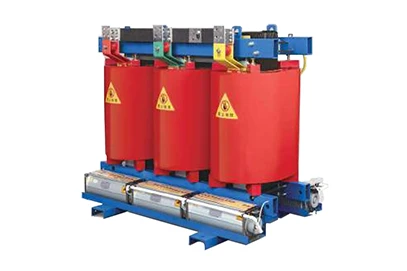
Two transformers with the same kVA rating can behave very differently. One may use a lower flux density and a more rigid core structure; another may rely on a simpler design that costs less but vibrates more. The enclosure also matters. A well-built low noise dry transformer often uses resin casting, internal bracing, and vibration damping to keep sound inside the unit.
What Causes Dry Transformer Noise?
The main source is magnetostriction. As the core is energized, the silicon steel sheets expand and contract slightly at twice the line frequency—100 Hz on a 50 Hz system, 120 Hz on a 60 Hz system. That creates the familiar low hum. Harmonics can add higher tones that are more annoying, even when the overall dB(A) reading is not very high.
Winding vibration, loose laminations, and cooling fans add to the problem. So does installation. A transformer bolted directly to a thin wall or placed in a corner can transfer vibration into the building structure. In that case, the room may sound louder than the transformer itself.
Core Magnetostriction and Winding Vibration
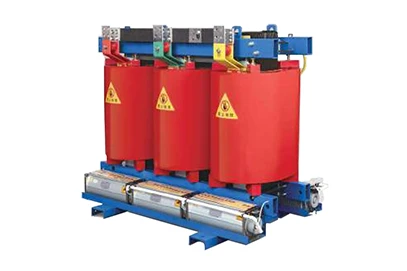
Core quality is the starting point. High-grade grain-oriented silicon steel, step-lap construction, and controlled flux density reduce magnetostriction. In an epoxy resin cast dry-type transformer, the windings are encapsulated in resin, which helps hold them firmly in place. That reduces movement and keeps the sound more stable over time.
Cooling Fans and Installation Factors
Fans are often the easiest noise source to overlook. They run only when temperature rises, but when they start, the sound can jump. Poor ventilation can also force fans to run longer. Meanwhile, weak foundations, rigid busbar connections, and shared walls can turn a normal hum into a building-wide complaint.
Practical Ways to Reduce Noise
Noise reduction is usually a combination of better equipment and better installation. You do not always need a custom acoustic enclosure. Sometimes a few changes at the design and commissioning stage are enough.
Choose a Low-Noise Core and Winding Design
When comparing dry transformer manufacturers, ask for sound-level data at the actual capacity and cooling mode you plan to use. Look for low-loss core designs, lower flux density, and cast resin windings. An energy efficient cast resin dry type transformer often runs cooler and quieter because it produces less loss and less thermal stress. SC(B) dry transformer designs are widely used for indoor distribution where noise and fire safety both matter.
Control Cooling Fan Noise
Use temperature-controlled fans that run only when needed. If your load profile allows, specify AN cooling for normal operation and keep AF as a backup. Choose low-noise fan blades and make sure the airflow path is clean. Dust buildup on fan blades and heat sinks can increase both temperature and noise.
Isolate Vibration at the Installation Point
Mount the unit on vibration isolators, spring mounts, or neoprene pads. Keep it away from lightweight walls and structural columns that can amplify sound. Use flexible connections for busbars and cables where possible. The goal is simple: stop vibration from traveling into the building.
Improve the Transformer Room
If the room is already built, acoustic treatment can help. Sound-absorbing panels, sealed doors, and lined ventilation ducts reduce reflected noise. But do not block airflow. A dry-type transformer depends on ventilation, so any acoustic solution must work with the cooling design, not against it. For data center and hospital projects, it is often better to plan the room around the transformer rather than fix it later.
Noise Standards and What to Specify
When you request a quote, do not just write “low noise.” Specify the sound pressure level in dB(A), the measurement distance, the capacity, and the cooling mode. Refer to IEC 60076-10 for sound-level measurement, or the applicable local standard. Ask for a test report from the factory. If the project has a strict limit—say, 45 dB(A) at 1 meter—state that clearly before the design is frozen.
FAQ
Is 50 dB(A) quiet enough for a dry-type transformer in a hospital?
It depends on where the unit sits. A dedicated electrical room with acoustic treatment can often handle 50 dB(A). If the room shares a wall with patient areas, aim lower and add isolation. Always compare the transformer sound level with the background noise of the space.
Do epoxy resin cast dry-type transformers run quieter than oil-immersed units?
Not automatically. Oil-immersed transformers have tank walls that can block some sound, while cast resin units rely on rigid windings and core design. The final result depends on the manufacturer, capacity, and installation. What cast resin units offer is oil-free, fire-resistant operation—an important advantage indoors.
Can I reduce noise after the transformer is already installed?
Yes, but the options are limited. You can add vibration isolators, adjust fan control, improve room acoustics, or install a sound enclosure. You cannot easily change the core or winding design. That is why it is better to discuss noise targets during the buying stage.
Does load level affect noise?
Load mainly affects winding vibration and fan operation. The core hum is present even at no load. As load rises, the unit may get warmer and fans may start, which increases the overall sound level. A stable, well-ventilated installation usually keeps this change under control.
Final Thoughts
Choosing the right Dry transformer for a noise-sensitive site is about more than comparing price. Ask for sound data, plan the installation, and match the cooling mode to the real load. A low-noise design, proper vibration isolation, and a well-treated room can turn a potential complaint into a non-issue. If you are sourcing for a data center, hospital, subway station, or commercial building, send us your capacity, voltage, installation details, and noise limit. Our team will help you select a cast resin dry type transformer that meets both performance and acoustic requirements.