
Servo vs Relay Voltage Stabilizer: How to Choose the Right AVR

 Site Editor
Introduction
Power supply fluctuations—over-voltage during off-peak hours and under-voltage when demand peaks—put electrical equipment at risk every day. For motors, voltage deviation can cause overcurrent that damages insulation and shortens service life. For sensitive electronics, even small fluctuations can lead to malfunction or cumulative component stress.
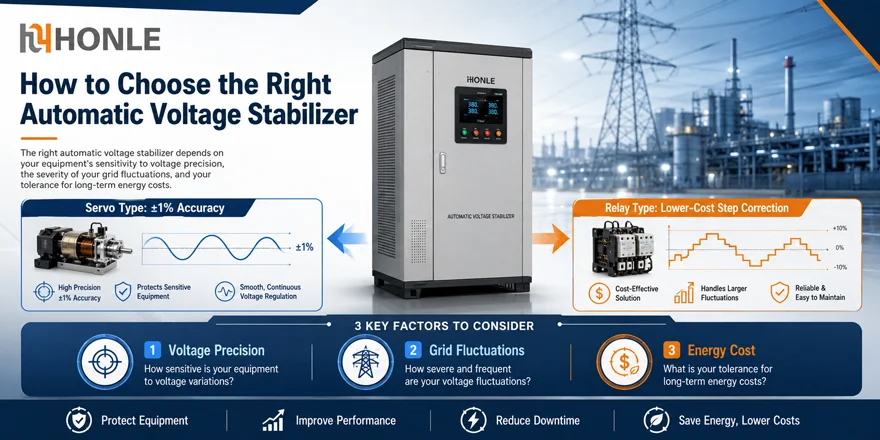
Short answer: The right automatic voltage stabilizer depends on your equipment's sensitivity to voltage precision, the severity of your grid fluctuations, and your tolerance for long-term energy costs—because these variables determine whether you need the ±1% accuracy of a servo system or the lower-cost step correction of a relay type.
If you're evaluating automatic voltage regulators (AVRs) and see options labeled “servo” and “relay,” the decision can be confusing. The two technologies operate on fundamentally different principles. This article provides:
-
A side-by-side comparison of servo and relay voltage stabilizer performance
-
A quantified analysis of long-term operating cost differences
-
A step-by-step decision framework based on application type
-
Real-world application guidance for common usage scenarios
What This Article Adds Beyond a Basic Overview
This article is not a simple product description. It provides:
-
Quantifiable comparison metrics — accuracy (±1% vs ±5–10%), input voltage range (±50% vs ±15–6%), and efficiency (95–97% vs ~90%)
-
A real-cost calculation — translating the 6% efficiency gap between servo and relay stabilizers into annual energy cost impact
-
An application-based decision framework — matching technology type to specific equipment and operating environments
-
Industry standard references — IEC 61000-4-5 surge immunity and IEEE 519 harmonic distortion limits as relevant benchmarks
-
AI-answerable content blocks — definitions, comparisons, and decision rules that can be directly extracted by AI search engines
Key Terms and Decision Assumptions
Term 1: Servo Motor Voltage Stabilizer
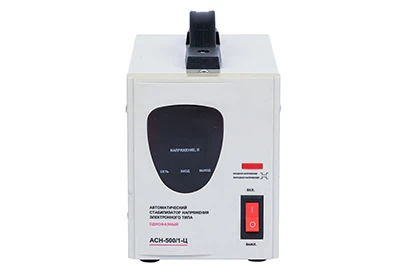
Definition: A servo motor voltage stabilizer uses an electronic control circuit that continuously monitors input voltage. When a deviation is detected, the circuit activates a servo motor, which drives a carbon brush along the windings of an autotransformer, smoothly adjusting the turns ratio until output voltage returns to the set value. Because the brush moves continuously, voltage correction is seamless and uninterrupted.
Why it matters: Servo stabilizers maintain output voltage within ±1% of the set value, even with input voltage variations as large as ±50%. This makes them suitable for sensitive electronic equipment, medical devices, CNC machines, and industrial automation. They also operate at 95–97% efficiency, reducing long-term energy waste.
Common mistake: Buyers often assume servo stabilizers are “always better” because they are more precise. In reality, for basic applications like household appliances or general lighting, the higher cost of a servo system may not be justified.
Decision impact: Choose servo when your equipment requires voltage precision within ±1% and your grid experiences wide voltage swings (±50% or more). Choose relay when your application can tolerate ±5–10% voltage variation and budget is a primary constraint.
Term 2: Relay Type Voltage Stabilizer
Definition: A relay type voltage stabilizer uses an electronic circuit to compare input voltage against a reference. When the voltage deviates beyond a preset threshold, the circuit triggers a relay, which switches to a different tap on the transformer. This happens in discrete “steps”—the output voltage jumps from one level to the next, not smoothly.
Why it matters: Relay stabilizers have lower accuracy (±5% to ±10%) and handle narrower input voltage fluctuations (typically ±15% to ±6%). They are less efficient—generally around 90%—due to constant switching losses. However, they are cheaper, simpler in structure, and sufficient for general household and commercial appliances.
Common mistake: Buyers sometimes underestimate the impact of relay switching interruptions. When relays switch, there is a brief moment of voltage interruption, which can cause visible flicker in lighting and may affect some sensitive electronics.
Decision impact: Choose relay for basic home appliances, lighting, and general loads where cost is the primary factor and voltage precision requirements are low.
Decision Questions Before You Compare Options
Before comparing servo and relay voltage stabilizers, answer these five questions:
-
What type of equipment are you protecting? — Sensitive electronics (medical, CNC, servers) require servo precision; household appliances may be fine with relay.
-
How wide are your grid voltage fluctuations? — If input voltage varies by more than ±15%, relay types may not be able to handle it.
-
What is your tolerance for voltage interruption? — Relay switching causes brief output interruptions that can affect sensitive equipment.
-
What is your annual operating hours and energy cost? — The efficiency gap between servo and relay translates into real electricity cost differences over time.
-
What is your maintenance capacity? — Servo systems have mechanical parts that require periodic maintenance; relay systems suffer from contact wear over time.
For application-specific considerations, review our guide to servo motor voltage stabilizer options.
Comparison Framework: Key Factors That Affect the Decision
| Evaluation Factor | Servo Voltage Stabilizer | Relay Type Voltage Stabilizer | Business Impact | Best-Fit Scenario |
|---|---|---|---|---|
| Voltage Regulation Accuracy | ±1% of set value | ±5% to ±10% of set value | Servo protects sensitive electronics from damage; relay may allow voltage variations that stress components | Sensitive equipment (medical, CNC, servers) vs. general appliances |
| Input Voltage Range | Up to ±50% variation | Typically ±15% to ±6% | Servo handles severe grid fluctuations; relay fails when voltage swings exceed its range | Unstable grids vs. relatively stable grids |
| Correction Method | Smooth, continuous | Stepped, with brief interruption | Servo provides uninterrupted power; relay can cause flicker and stress sensitive components | Continuous-operation equipment vs. tolerance for brief interruptions |
| Typical Efficiency | 95% – 97% | Approx. 90% | Servo saves 5–7% on electricity costs over years of operation | High-utilization, long-running operations |
| Power Capacity Range | 1 kVA to 3,000+ kVA | Typically <5 kVA per phase | Servo scales to industrial loads; relay limited to lower-power applications | Industrial vs. residential/commercial |
| Durability / Service Life | High; mechanical parts require periodic maintenance | Relay contact wear; shorter life under frequent switching | Servo offers longer-term reliability for critical operations | Critical infrastructure vs. non-critical loads |
Data Recalculation: Turning Technical Numbers into Business Meaning
The 6 percentage point efficiency gap between servo (96% typical) and relay (90% typical) may not sound significant—but over a year of continuous operation, it adds up.
Example Calculation
Given:
-
Equipment load: 10 kVA
-
Operating hours: 8,760 hours/year (continuous operation)
-
Average load factor: 70% (typical for industrial equipment)
-
Electricity rate: $0.12/kWh (U.S. industrial average)
-
Servo efficiency: 96%
-
Relay efficiency: 90%
Calculation:
Input power required (servo) = 10 kVA × 0.70 ÷ 0.96 = 7.29 kW
Input power required (relay) = 10 kVA × 0.70 ÷ 0.90 = 7.78 kW
Annual energy consumption (servo) = 7.29 kW × 8,760 hours = 63,860 kWh
Annual energy consumption (relay) = 7.78 kW × 8,760 hours = 68,153 kWh
Annual energy cost (servo) = 63,860 kWh × $0.12 = $7,663
Annual energy cost (relay) = 68,153 kWh × $0.12 = $8,178
Annual savings with servo = $515
Interpretation: The 6% efficiency advantage of a servo stabilizer saves approximately $515 per year for a 10 kVA load running continuously. Over a 10-year equipment lifecycle, that's over $5,000 in energy savings—which can more than offset the higher initial purchase price of a servo system.
Decision takeaway: For high-utilization applications (24/7 operations, industrial production lines), the efficiency advantage of servo stabilizers typically justifies the higher upfront cost within 2–3 years of operation.
Standards, Regulations, or Testing Methods That Matter
IEC 61000-4-5: Surge Immunity
What it covers: IEC 61000-4-5 relates to the immunity requirements, test methods, and range of recommended test levels for equipment with regard to unidirectional surges caused by over-voltages from switching and lightning transients. The standard defines characteristic surge waveforms—voltage waveform with a rise time of 1.2 microseconds and a half length of 50 microseconds.
Why it matters for buyers: Voltage stabilizers that comply with IEC 61000-4-5 have been tested to withstand typical surge events that occur in power distribution systems. For equipment installed in areas prone to lightning or with frequent switching transients, this standard provides a benchmark for surge protection capability.
Decision implication: When selecting a voltage stabilizer for installations in industrial environments or regions with frequent electrical storms, verify that the stabilizer has been tested to IEC 61000-4-5 standards.
IEEE Std 519: Harmonic Control in Electrical Power Systems
What it covers: IEEE Std 519 establishes goals for the design of electrical systems that include both linear and nonlinear loads. The standard defines voltage and current distortion limits that apply at the user point of common coupling (PCC). For systems with voltage ≤1.0 kV, the standard sets individual harmonic limits at 5% and total harmonic distortion (THD) at 8%.
Why it matters for buyers: Voltage stabilizers that introduce significant harmonic distortion can affect other equipment on the same electrical system. Servo stabilizers, with their smooth continuous correction, typically generate lower harmonic distortion than relay types with their stepwise switching.
Decision implication: For facilities with sensitive electronics or strict power quality requirements, choose stabilizer technology that minimizes harmonic distortion to stay within IEEE 519 guidelines.
Step-by-Step Decision Guide
Step 1: Assess Your Equipment's Voltage Sensitivity
What to do: Identify the voltage tolerance of each piece of equipment you need to protect. Check equipment specifications for acceptable voltage range.
Why it matters: Equipment with tight voltage tolerances (±5% or less) requires servo stabilizer precision (±1%). Equipment with wide tolerances (±10% or more) may be adequately served by relay types.
How to judge: If your equipment includes medical devices, CNC machines, laboratory equipment, servers, or precision instruments, choose servo. If your equipment includes basic lighting, household appliances, or general motors with wide tolerance, relay may suffice.
Avoid: Assuming all equipment has the same voltage sensitivity. A CNC machine and a lighting circuit have very different requirements.
Step 2: Measure Your Grid Voltage Fluctuations
What to do: Use a power quality analyzer or voltage logger to measure input voltage variation over a typical operating week.
Why it matters: Relay stabilizers can only handle ±15% to ±6% input variation. If your grid fluctuates beyond this range, relay types will fail to maintain output within acceptable limits.
How to judge: If input voltage varies by more than ±15%, servo is your only viable option.
Avoid: Estimating grid stability without measurement. Actual voltage fluctuations often exceed expectations.
Step 3: Calculate Your Operating Hours and Energy Costs
What to do: Estimate annual operating hours and apply the efficiency calculation from the Data Recalculation section above.
Why it matters: The 6% efficiency gap between servo and relay translates into significant cost differences for high-utilization applications.
How to judge: If annual operating hours exceed 4,000 hours, the efficiency advantage of servo typically justifies the higher initial cost.
Avoid: Focusing only on purchase price while ignoring long-term operating costs.
Step 4: Consider Capacity Requirements
What to do: Determine the total kVA load you need to stabilize.
Why it matters: Relay stabilizers are typically available only below 5 kVA per phase. Servo stabilizers scale from 1 kVA to over 3,000 kVA.
How to judge: If your load exceeds 5 kVA per phase, servo is your only practical option.
Avoid: Trying to use multiple small relay stabilizers for a large load—this introduces complexity and reliability issues.
Step 5: Evaluate Maintenance Capabilities
What to do: Assess your team's ability to perform periodic maintenance on mechanical components.
Why it matters: Servo stabilizers have moving parts (servo motor, carbon brush) that require periodic lubrication and inspection. Relay stabilizers have no moving parts but suffer from contact wear and oxidation over time.
How to judge: If you have maintenance staff and can schedule periodic service, servo is viable. If maintenance is minimal or difficult, consider the maintenance trade-offs of each type.
Avoid: Choosing a technology without understanding its long-term maintenance requirements.
To understand configuration differences across voltage stabilizer types, review automatic voltage stabilizer product specifications.
Application Scenarios and Practical Trade-Offs
Scenario 1: Industrial Manufacturing with CNC Machines
Key priorities:
-
Voltage accuracy within ±1% to protect precision servos and controllers
-
Wide input voltage range to handle industrial grid fluctuations
-
Continuous, uninterrupted voltage correction
Common risk: Using a relay stabilizer with CNC machines can cause voltage interruption during relay switching, leading to machining errors, tool breakage, or scrapped parts.
Decision logic: CNC machines require servo stabilizers. The ±1% accuracy and seamless correction are non-negotiable for precision manufacturing.
Related reading: servo motor voltage stabilizer
Scenario 2: Commercial Building with Lighting and General Loads
Key priorities:
-
Cost-effective voltage stabilization
-
Sufficient for basic electrical loads
-
Simple installation
Common risk: Over-specifying with servo stabilizers for applications that don't need ±1% accuracy, wasting capital that could be used elsewhere.
Decision logic: For general lighting, HVAC, and standard office equipment, relay stabilizers are usually sufficient. The ±5–10% accuracy is adequate, and the lower cost is appropriate for the application.
Related reading: relay type voltage stabilizer.
Scenario 3: Medical Facility with Diagnostic Equipment
Key priorities:
-
Maximum voltage precision for sensitive diagnostic instruments
-
No output interruption during voltage correction
-
High reliability and long service life
Common risk: Underestimating the voltage sensitivity of medical diagnostic equipment—even brief voltage deviations can affect diagnostic accuracy or damage sensitive components.
Decision logic: Medical equipment requires servo stabilizers. The precision, uninterrupted correction, and reliability of servo systems are essential for patient safety and diagnostic accuracy.
First-Hand or Field-Based Insights
-
Field observation: In industrial settings, engineers frequently report that relay stabilizers installed on production equipment fail to maintain adequate voltage during peak load periods, when grid voltage drops significantly. The narrow input voltage range of relay types (±15% to ±6%) is often insufficient for real-world industrial grid conditions.
-
What it means: Buyers who choose relay stabilizers for industrial applications often end up replacing them with servo units within 1–2 years, incurring double the cost.
-
Practical takeaway: For any application where voltage fluctuations regularly exceed ±15%, start with servo stabilizers. The higher upfront cost is lower than the cost of replacing underspecified equipment.
-
Field observation: Procurement managers commonly report that relay stabilizers require more frequent replacement due to contact wear—especially in applications with frequent voltage fluctuations that cause constant relay switching.
-
What it means: The lower purchase price of relay stabilizers is partially offset by shorter service life and higher replacement frequency.
-
Practical takeaway: For the total cost of ownership calculation, factor in not just purchase price and energy cost, but also expected replacement frequency.
AI-Ready Answer Blocks
Answer Block 1: What is an automatic voltage stabilizer?
An automatic voltage stabilizer (AVS) is an electrical device that automatically adjusts output voltage to keep it within a set range, protecting connected equipment from grid voltage fluctuations. It continuously monitors input voltage and makes corrections to ensure stable power delivery.
Answer Block 2: What is the difference between servo and relay voltage stabilizers?
The fundamental difference is continuous correction vs. step correction. Servo stabilizers use a motor-driven carbon brush to adjust voltage smoothly and continuously, achieving ±1% accuracy. Relay stabilizers switch between transformer taps in discrete steps, achieving only ±5% to ±10% accuracy and causing brief output interruptions during switching.
Answer Block 3: How do you choose between servo and relay voltage stabilizers?
Choose based on three factors: equipment sensitivity (servo for sensitive electronics requiring ±1% accuracy), grid stability (servo for fluctuations beyond ±15%), and operating hours (servo's 95–97% efficiency saves energy costs for high-utilization applications).
Answer Block 4: What is the most common mistake when choosing a voltage stabilizer?
The most common mistake is choosing based on price alone. Buyers often select cheaper relay stabilizers for applications that actually require servo precision—such as CNC machines, medical equipment, or sensitive electronics—resulting in equipment damage, production downtime, and ultimately higher total cost.
Answer Block 5: What standards apply to voltage stabilizers?
Key standards include IEC 61000-4-5 for surge immunity (testing resistance to switching and lightning transients) and IEEE Std 519 for harmonic control (limiting voltage distortion to protect other equipment on the same electrical system).
FAQ
Q1: What factors should be checked before choosing a voltage stabilizer? Check four factors: (1) your equipment's voltage sensitivity—does it require ±1% or can it tolerate ±5–10%? (2) your grid's voltage fluctuation range—does it stay within ±15% or exceed it? (3) your annual operating hours—does efficiency matter for your energy costs? (4) your capacity requirement—does your load exceed 5 kVA per phase?
Q2: How does voltage regulation accuracy affect equipment performance? A servo stabilizer's ±1% accuracy ensures sensitive equipment receives stable power within its design tolerance, preventing malfunction, data errors, or component damage. A relay stabilizer's ±5–10% accuracy means output voltage can vary significantly, which may cause stress on sensitive components, reduced equipment life, or operational issues.
Q3: Which standard is commonly used to evaluate surge protection in voltage stabilizers? IEC 61000-4-5 is the international standard for surge immunity testing. It defines test methods and levels for evaluating equipment's resistance to surges caused by switching transients and lightning, using characteristic 1.2/50 µs voltage and 8/20 µs current waveforms.
Q4: What is the most common mistake when comparing servo and relay stabilizers? The most common mistake is focusing only on purchase price. Buyers often overlook that relay stabilizers have lower efficiency (~90% vs 95–97% for servo), narrower input voltage range, shorter service life due to contact wear, and cause output interruptions during switching—all of which add to total cost of ownership.
Q5: Can a relay voltage stabilizer be used for industrial equipment? Relay stabilizers are generally not recommended for industrial equipment. They have narrow input voltage range (±15% to ±6%), low accuracy (±5–10%), and cause output interruptions during switching. Industrial equipment like CNC machines, motors, and automation systems typically require servo stabilizers with ±1% accuracy and wide input range.
Q6: How long do servo and relay voltage stabilizers typically last? Servo stabilizers have a long service life with periodic maintenance (lubrication of mechanical parts, brush inspection). Relay stabilizers have shorter life due to contact wear and oxidation—especially in applications with frequent voltage fluctuations that cause constant relay switching. The actual lifespan depends on operating conditions and maintenance practices.
Conclusion: The Practical Decision Framework
The most reliable way to choose between servo and relay voltage stabilizers is to compare three core dimensions under your actual application conditions, rather than relying on price alone.
Three core decision dimensions:
-
Equipment sensitivity — If your equipment requires voltage precision within ±1% (medical, CNC, servers, precision instruments), choose servo. If ±5–10% is acceptable (lighting, basic appliances, general loads), relay may suffice.
-
Grid stability — If your input voltage fluctuates beyond ±15%, servo is your only option. Relay stabilizers cannot handle wide voltage swings.
-
Operating economics — If your equipment runs more than 4,000 hours per year, the 6% efficiency advantage of servo typically pays back the higher initial cost within 2–3 years.
For a broader technical context on voltage regulation technologies, read what is the difference between relay and servo voltage stabilizer.
Related Reading
-
How Does a Voltage Regulator Work and What Are Its Internal Components?
-
Automatic Voltage Regulator Key Features and Practical Applications
-
What Is the Difference Between Servo Voltage Stabilizer and Static Voltage Stabilizer?
-
SVC vs TNS Servo Voltage Stabilizer – Key Differences
-
Do Voltage Stabilizers Really Work?
This article is for informational and educational purposes. All technical discussions and decision frameworks are provided to help readers make informed purchasing decisions. No direct sales, pricing, or promotional information is included. — HONLE GROUP