
Is a Servo Voltage Stabilizer Worth It for Medical Equipment? | Honle

 Site Editor
A hospital operating room relies on a ventilator that must run without interruption. An imaging suite is performing a CT scan that requires consistent X-ray output for an accurate diagnosis. A laboratory analyzer is processing patient blood samples that cannot be rerun.
In each of these scenarios, the common denominator is not the device itself—it is the quality of the electrical power feeding it. Voltage sags, surges, and fluctuations are not merely inconveniences in healthcare settings. They can produce diagnostic errors, trigger unexpected equipment shutdowns, and in the case of life-support systems, create direct patient safety risks. If you manage or operate medical equipment, you have likely encountered unexplained device faults, image artifacts, or calibration drift.
This article examines how voltage instability affects different categories of medical equipment, compares servo-based voltage regulation against lower-cost alternatives, and provides a framework to determine whether a servo stabilizer is a necessary investment or an avoidable expense for your facility.

How Voltage Instability Affects Medical Equipment—Types and Consequences
Understanding whether a servo stabilizer is worthwhile begins with understanding what is at stake. Medical equipment varies widely in its sensitivity to voltage fluctuations, and the consequences of inadequate power quality differ by device type.
Diagnostic imaging equipment. Imaging devices need accurate power inputs for steady image quality. X-ray generators require stable tube voltage for uniform X-ray spectra. Studies show voltage ripple changes X-ray output 45%–82% vs constant-potential units. In medical X-ray systems, 1% voltage fluctuation leads to 5%–8% gray-scale deviation, and 0.5% current fluctuation cuts signal-to-noise ratio by 10%. Intraoperative CT power supplies must restore voltage within 3ms at ±0.5% tolerance; slow recovery distorts detector sampling and blurs moving organ scans. Unstable power forces repeat scans, raising patient radiation exposure and wasting clinical time.
Life-support and monitoring equipment. Risks are critical. Past research shows hospital grid interference disrupts mains medical gear, with recurring voltage drops blowing fuses on life-support devices. Recent data proves slight power swings trigger faults or sudden shutdowns in ventilators and monitors. Unlike imaging units that only yield low-quality scans, unstable power here may halt vital treatment entirely.
Diagnostic laboratory equipment. Voltage fluctuations cause measurement inaccuracies. Diagnostic devices rely on stable voltage; minor shifts skew readings and trigger false alerts. For lab analyzers handling time-critical samples, faulty results lead to wrong treatment calls or repeated sampling and testing.
General medical electrical equipment. the key EMC standard for medical electrical devices, outlines tests for voltage dips, brief outages and fluctuations. Its fourth edition states testing may be done at a single rated voltage if the gap between max and min rated voltage is under 25% of the maximum value. This means makers design for defined power immunity, not full resistance. The standard only lays out baseline performance thresholds, not complete protection against all actual grid irregularities.
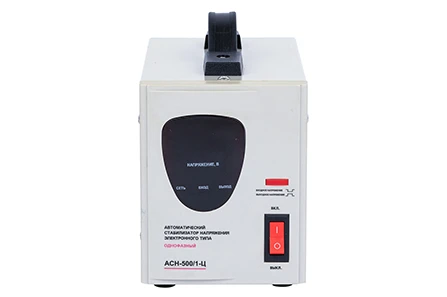
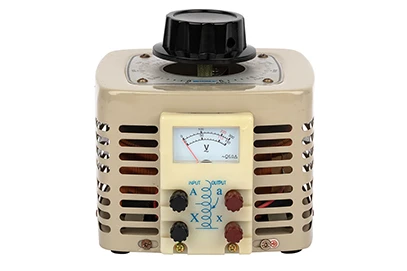
For a detailed comparison of stabilizer technologies designed for medical applications, visit our servo automatic voltage stabilizer series page.
Servo vs Relay vs Static Stabilizers—What Matters for Medical Equipment
Not all automatic voltage regulators (AVRs) are created equal for medical applications. The table below compares three common stabilizer technologies across parameters that directly affect medical device performance.
| Parameter | Servo Stabilizer | Relay Stabilizer | Static Stabilizer |
|---|---|---|---|
| Voltage regulation accuracy | ±1% | ±5% to ±10% | ±0.5% to ±1% |
| Correction method | Continuous | Stepped | Instantaneous |
| Output interruption during correction | None | Brief interruption | None |
| Typical efficiency | 95% – 97% | Approx. 90% | Up to 98% |
| Response time | 20–70 ms per volt | 30–40 ms | < 5 ms |
| Mechanical wear | Moderate | Moderate | None |
| Noise level | Low to moderate | Low | Silent |
| Typical capacity range | 1 kVA to 3,000+ kVA | < 5 kVA per phase | 1 kVA to 500+ kVA |
| Best for medical use | General imaging, lab, and clinical equipment | Not recommended for sensitive medical devices | MRI, surgical navigation, critical care |
Note: All parameters listed are typical industry reference values.
Why accuracy matters for medical devices. A servo stabilizer maintaining ±1% output voltage means that for a device expecting 230 V, the delivered voltage stays between 227.7 V and 232.3 V. A relay stabilizer at ±8% could deliver anywhere from 211.6 V to 248.4 V—a range large enough to push many medical devices outside their optimal operating window.
Why continuous correction matters. Relay stabilizers adjust voltage in steps. When input voltage crosses a threshold, relays physically switch to a different transformer tap, causing a momentary output interruption perceptible as flicker in lighting. For medical imaging, that momentary output change can appear as an artifact in a captured image. For monitoring equipment, it could be mistaken for a physiological event.
When servo may not be enough. In extremely low input voltage conditions, a servo motor’s brush must travel a long distance to correct, which can take considerable time. In such environments, static stabilizers may be preferable. For most healthcare facility settings where voltage drops are moderate rather than extreme, servo stabilizers offer the optimal balance of accuracy, reliability, and cost.
For guidance on how these technologies apply to specific medical environments, explore our power solutions for healthcare and industrial applications.
A Practical Decision Framework—Four Steps to Assess Your Needs
Follow this step-by-step process to determine whether a servo voltage stabilizer is justified for your medical equipment.
Inventory your equipment and classify by sensitivity. Not every device needs servo-grade precision. Create an inventory and categorize equipment into three tiers:
| Sensitivity Tier | Equipment Examples | Recommended Stabilizer |
|---|---|---|
| Critical precision | MRI, CT, X-ray, PET-CT, surgical navigation systems | Servo or static |
| High sensitivity | Ventilators, patient monitors, infusion pumps, laboratory analyzers, and ultrasound | Servo |
| Standard tolerance | Lighting, HVAC, general receptacles, battery-charged devices | No stabilizer or relay |
Battery-operated mains-rechargeable devices are generally unaffected by mains voltage variations including drop-outs and sags—they can often be excluded from stabilizer consideration.
Measure your actual power quality. Before investing, understand what you are protecting against. Install a power quality logger at your facility’s main electrical panel and at sensitive equipment locations for at least one week. Record:
-
Minimum and maximum voltage
-
Number and severity of voltage sags
-
Frequency of voltage swells
-
Voltage imbalance between phases
-
Harmonic distortion levels
If measured variations consistently exceed your critical equipment’s tolerance, power protection is justified. If variations are minimal or equipment is already protected by internal power supplies with wide input ranges, a stabilizer may add little value.
Estimate the cost of inaction. Calculate the financial impact of voltage-related equipment issues over a 3–5 year period:
-
Repeat scans from image artifacts. Each repeated CT or MRI represents lost revenue, increased wear on the equipment, and patient inconvenience.
-
Maintenance and repair costs. Case study data from hospital installations indicate that after installing servo stabilizers, maintenance expenses can be reduced by approximately 40%.
-
Equipment downtime. An hour of downtime for a high-use MRI suite can represent hundreds or thousands of dollars in lost clinical revenue.
-
Premature equipment replacement. Voltage stress accumulates over time. Equipment that might have lasted 10 years may require replacement in 7–8 years without stable power.
Calculate total cost of ownership for the stabilizer. A servo stabilizer’s initial purchase price is higher than a relay unit. However, efficiency differences matter. A servo unit operating at 96% efficiency wastes 4% of energy as heat; a relay unit at 90% efficiency wastes 10%. For a 50 kVA medical imaging load running 12 hours per day, that 6% efficiency difference represents approximately 3,600 kWh per year of additional electricity consumption for the relay unit.
Industry sources suggest that the average payback period for a servo controlled voltage stabilizer, owing to its energy saving capability, is approximately 18 months. When combined with reduced equipment maintenance costs and extended equipment lifespan, the total cost of ownership for a properly sized servo stabilizer is often lower than the cumulative costs of no protection or inadequate protection.
Real-World Applications—From Large Hospitals to Small Clinics
To make this concrete, consider two different healthcare scenarios.
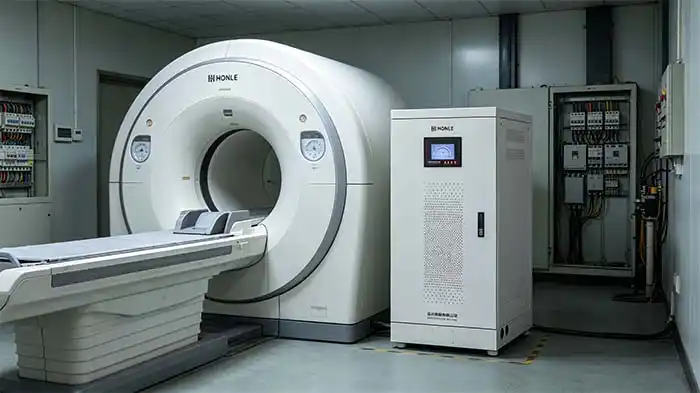
- Large multi-specialty hospital with imaging center. A hospital in a region with frequent voltage fluctuations experienced repeated faults in X-ray machines, MRI scanners, and ICU equipment. The situation became critical during peak power demand hours. After installing appropriately sized servo stabilizers—including a 50 kVA unit for key imaging equipment—the hospital observed noticeable improvement in equipment lifespan, zero interruptions in ventilators and monitoring systems, maintenance expenses reduced by nearly 40%, and increased confidence in ICU and emergency care services.
- Small outpatient clinic with one X-ray unit and basic lab equipment. A small clinic operates a single digital X-ray system and two hematology analyzers. Voltage fluctuations are mild but noticeable during afternoon peak demand. The clinic’s power quality assessment shows occasional sags to 200 V. For this situation, a properly sized servo stabilizer for the X-ray system—or a small servo unit protecting both the X-ray and laboratory equipment—would be a justifiable investment to prevent repeat exposures and maintain accurate lab results.
- Battery-protected mobile medical units. Mobile clinics and battery-backed devices present a different profile. Equipment that is battery-operated and mains-rechargeable is generally unaffected by voltage variations, as the battery acts as a natural power conditioner. For such equipment, a separate voltage stabilizer may not be necessary unless the battery charging system itself is sensitive.
Next Steps—From Decision to Specification
By now, you should be able to assess your facility’s situation: if you operate diagnostic imaging equipment, life-support devices, or precision laboratory analyzers in an area with documented voltage fluctuations, the case for a servo stabilizer is strong. The key decision factors are the sensitivity of your most critical equipment, the measured severity of voltage variations at your site, and the cost of inaction for your specific clinical context.
Once you have clarified these parameters, comparing the specific capacity, input voltage range, and protection features of available servo stabilizers becomes the logical next step. You can review Honle’s servo automatic voltage stabilizer series for medical-grade applications across a range of capacities.
For a related selection guide, see our article: How to Choose the Correct Capacity and Phase Configuration for Your Voltage Stabilizer – coming soon.
Related Reading
-
Voltage Stabilizer Placement in Healthcare Facilities – Centralized vs Point-of-Use
-
Understanding Input Voltage Range Requirements for Medical Equipment
-
How to Perform a Power Quality Audit for Your Hospital or Clinic
-
SVC vs TNS Servo Voltage Stabilizer – Key Differences | Honle
-
Maintenance Best Practices for Servo Stabilizers in Continuous Medical Service
This article is part of Honle’s technical content library. No direct sales or pricing information is included. All technical discussions aim to help you make informed purchasing decisions.