
Reduce Voltage Fluctuation Downtime with Fast-Response AVR | Honle

 Site Editor
Your production line is running at full capacity. Then, without warning, machines shut down. Control panels go dark. Motors stop. The cause? A voltage sag that lasted less than a second—but the ripple effect will last for hours. In automated manufacturing, even a brief voltage dip can halt operations, waste materials, and trigger costly restarts. According to the Electric Power Research Institute (EPRI), voltage sags and swells are the most common cause of downtime in industrial facilities. The question is not whether your facility will experience voltage fluctuations—it is how quickly your protection system can respond when they occur. This article explains the relationship between AVR response time and operational downtime, compares different technologies, and provides a framework for selecting the right fast-response voltage regulator for your application.
Understanding the Cost of Voltage Fluctuations – Why Milliseconds Matter
Before examining how fast-response AVRs work, it is essential to understand what is at stake when voltage fluctuates.
Voltage sags and swells can have immediate and severe consequences for industrial operations. A single voltage sag can:
-
Force sensitive machinery to reset or shut down completely
-
Halt production lines for minutes or hours
-
Damage critical electronic components
-
Create material waste and quality defects
-
Require costly cleaning and re-start procedures
The financial impact is substantial. In the plastics industry, even short voltage micro-outages can cause unexpected machine shutdowns and material scrap, with costs estimated at €5,000-€50,000 per hour of downtime. One industrial group recorded approximately 600 micro-interruption events per year, with management estimating total losses at over €200,000 annually when considering direct and indirect costs.
Another real-world example: A company experiencing voltage sag events estimated that each sag-related downtime event cost approximately $5,000** on average when lost production time and waste were factored in, with annual losses reaching **approximately $100,000. Even isolated power quality incidents can result in substantial losses—for instance, a 50 hp motor failure leading to 4 hours of downtime at $6,000 per hour totals $29,000.
Globally, poor power quality is estimated to cost businesses more than US$160 billion annually.
The common thread across all these examples is time. The duration of a voltage disturbance—and the speed with which it is corrected—directly determines whether equipment trips, production stops, or operations continue uninterrupted.
For an overview of voltage stabilizer technologies designed for industrial protection, visit our automatic voltage stabilizer series page.
AVR Response Time – What the Numbers Actually Mean
Not all voltage regulators respond at the same speed. Understanding response time specifications is critical to selecting the right protection.
Response time is the interval between the moment a voltage deviation occurs and the moment the AVR begins to correct it. A related metric, correction time, is the total time required to restore output voltage to the nominal level.
| Technology Type | Typical Response Time | Typical Correction Time | Key Characteristics |
|---|---|---|---|
| Servo Stabilizer | 20–100 ms | 0.5–2 seconds | Mechanical moving parts; gradual adjustment; requires maintenance |
| Relay / Tap-Changing Stabilizer | < 30 ms | 100–200 ms | Discrete step correction; brief output interruption during switching |
| Static / Thyristor AVR | < 10 ms | 100–200 ms | Solid-state, no moving parts; instant response; maintenance-free |
| Dynamic Voltage Regulator | ≤ 1 ms | < 3 ms | Advanced power electronics; full compensation; highest performance |
What this means for your equipment:
-
A10 ms response time means the AVR detects and begins correcting a voltage sag before most industrial control systems can react—often preventing the fault from propagating.
-
A1–2 second response time means equipment may already have tripped or reset before correction begins.
For context, IEC 61000-4-11—the international standard for evaluating equipment immunity to voltage dips and interruptions—establishes test levels that simulate real-world power disturbances. Equipment that relies solely on internal immunity may pass laboratory tests but still fail in the field if the AVR cannot correct fast enough.
Fast-Response AVR Technologies – A Comparison
Different fast-response technologies offer different trade-offs. The table below compares the key options for industrial applications.
| Parameter | Static (Thyristor) AVR | Dynamic Voltage Regulator | High-Speed Servo AVR |
|---|---|---|---|
| Response time | < 10 ms | ≤ 1 ms | 20–40 ms |
| Correction method | Thyristor switching, no moving parts | Semiconductor / supercapacitor-based | Motor-driven carbon brush |
| Typical efficiency | > 97% | > 98% | 95–97% |
| Maintenance requirement | Low | Low | Moderate |
| Voltage correction range | Up to ±60% | Up to 100% voltage drop compensation | ±20–50% |
| Best suited for | General industrial, CNC, telecom | Critical processes, sensitive electronics | Standard industrial loads |
Static thyristor-based AVRs offer a compelling balance of speed, efficiency, and low maintenance. Units with response times under 10 milliseconds and efficiency exceeding 98% are available for industrial applications. These devices inject corrective voltage through thyristor switches for fast, precise regulation without moving parts.
For the most demanding applications—where even a few milliseconds of disturbance can cause production loss—dynamic voltage regulators can achieve response times of 1 millisecond or less, supporting full compensation of voltage drops. Some advanced systems using supercapacitor technology can restore nominal voltage levels in under 3 milliseconds.
For guidance on selecting the right stabilizer for different industrial environments, explore our power solutions for industrial applications.
A Practical Decision Framework – Matching Response Speed to Your Application
Not every application requires the fastest possible response. Use this step-by-step framework to determine the appropriate response time for your facility.
Classify your equipment by sensitivity.
| Sensitivity Level | Equipment Examples | Recommended Response Time |
|---|---|---|
| Extremely sensitive | CNC machining centers, PLC-controlled systems, medical imaging, semiconductor equipment | < 10 ms |
| Highly sensitive | Industrial robots, automated packaging lines, data servers | 10–30 ms |
| Moderately sensitive | Motors, pumps, compressors, lighting systems | 30–100 ms |
| Low sensitivity | Heating elements, basic lighting, battery-charged devices | > 100 ms |
Measure the severity and frequency of voltage events at your site. Install power quality monitoring for at least one week. Record:
-
Number of voltage sags below 90% of nominal
-
Duration of each event
-
Depth of each sag
-
Time of day when events occur
Calculate the cost of a typical event. Multiply your estimated downtime cost per hour by the average recovery time. If sag events occur frequently, even short recovery times can accumulate significant annual losses.
Match response time to event duration. If your typical voltage sag lasts 20–50 milliseconds, an AVR with a 10 ms response time can correct it before equipment trips. If your events are longer, correction time becomes equally important.
Factor in maintenance and total cost of ownership. Static AVRs with no moving parts offer lower long-term maintenance costs compared to servo-based systems. While the upfront cost may be higher, reduced downtime and maintenance expenses often justify the investment.
Real-World Application Scenarios
To illustrate how response time translates to operational results, consider these examples.
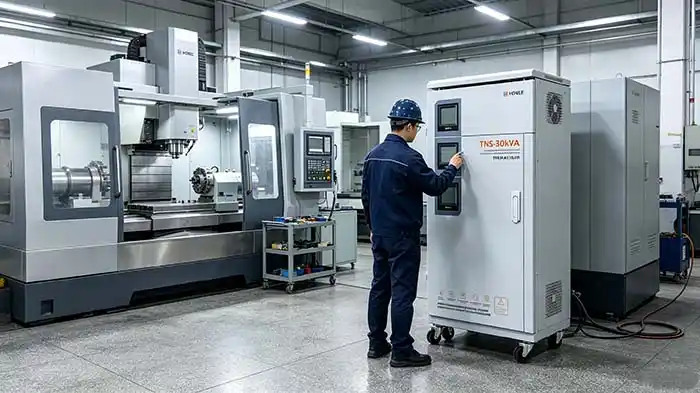
CNC Machining Workshop. A facility operates five CNC machining centers. Voltage sags occur 10–15 times per day due to nearby industrial loads. Each sag lasts 30–50 ms and causes the CNC controllers to fault, requiring 5–10 minutes of re-homing and recalibration. With 5 machines and 15 events per day, total daily downtime is approximately 75–150 minutes. At an estimated cost of $200 per minute in lost production, annual losses exceed $500,000. Installing a static AVR with < 10 ms response time eliminates virtually all sag-related faults, as correction occurs before the CNC control system can detect the disturbance.
Plastic Film Extrusion Line. An extrusion facility experiences approximately 600 voltage micro-interruption events per year, with voltage drops down to 90% of nominal. Each event causes material scrap and line stoppages. With downtime costs estimated at €5,000–50,000 per hour, even short interruptions carry significant costs. Installing a dynamic voltage regulator with response time under 3 ms—faster than the equipment’s own fault detection—prevents the line from stopping altogether, eliminating scrap and restart costs.
Data Center with Sensitive IT Equipment. A data center experiences voltage sags during utility switching events. Servers and storage systems are sensitive to even brief voltage deviations. A static AVR with < 10 ms response time and > 98% efficiency protects the IT load continuously, with no moving parts to maintain and minimal energy losses.
Next Steps – From Understanding to Selection
By now, you should be able to assess your facility’s requirements: the sensitivity of your equipment, the frequency and severity of voltage events at your site, and the cost of unplanned downtime. The key decision factors are response time, correction time, maintenance requirements, and total cost of ownership.
Once you have clarified these parameters, comparing the specific response time specifications and protection features of available AVR models becomes the next logical step. You can review static/thyristor-type automatic voltage regulators for maintenance-free, millisecond-response protection, or explore servo-type stabilizers for standard industrial applications where cost is a primary consideration.
Related Reading
-
How to Measure Voltage Sag Frequency and Severity at Your Facility
-
Servo vs Static Voltage Stabilizer – A Maintenance Comparison
-
Understanding IEC 61000-4-11 and What It Means for Your Equipment
-
Voltage Stabilizer Sizing Guide – Calculating the Right Capacity for Your Load
-
Common Power Quality Issues in Industrial Environments and How to Solve Them
This article is part of Honle’s technical content library. No direct sales or pricing information is included. All technical discussions aim to help you make informed purchasing decisions.