
How Often to Clean Carbon Brushes on Servo Voltage Stabilizer? | Honle

 Site Editor
Your servo voltage stabilizer has been protecting your equipment faithfully for months. But behind the panel, a small component is gradually wearing down with every voltage adjustment it makes: the carbon brush. Unlike static electronic devices, servo stabilizers rely on a mechanical system—a servo motor drives a carbon brush across the windings of a transformer to regulate output voltage. This mechanical contact creates friction, and friction creates wear. Over time, carbon dust accumulates, the brush surface becomes contaminated, and the contact resistance increases. If you have ever wondered whether your stabilizer needs maintenance, how often you should open it up, or what signs indicate that cleaning is overdue, this guide provides a practical framework based on manufacturer recommendations and industry practice.
Why Carbon Brushes Need Regular Cleaning—And What Happens If You Skip It
Before discussing cleaning frequency, it helps to understand what the carbon brush does and why it requires attention.
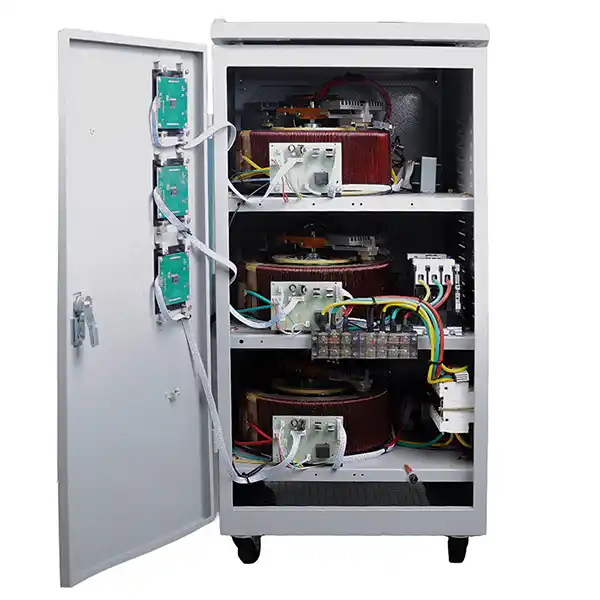
In a servo voltage stabilizer, the carbon brush slides along the exposed windings of an autotransformer. As the servo motor moves the brush, the turns ratio changes, adjusting the output voltage. This is a mechanical process: the brush makes physical contact with the coil surface, and every movement causes microscopic wear. The wear produces carbon dust, which can accumulate on the coil surface and around the brush assembly.
What happens when you skip cleaning:
| Issue | Consequence |
|---|---|
| Carbon dust buildup on the coil | Increases contact resistance, causing overheating and voltage regulation errors |
| Contaminated brush surface | Poor electrical contact leads to sparking, which damages the coil surface |
| Excessive brush wear | Reduced contact area causes arcing, overheating, and eventual stabilizer failure |
| Dust accumulation on components | Traps heat, reduces cooling efficiency, and accelerates aging of surrounding components |
The contact surface between the coil and the carbon brush must be kept clean at all times. If contaminated, excessive sparking may occur, damaging the coil surface. When carbon brush wear exceeds approximately 80%, the stabilizer can no longer maintain proper contact, and replacement becomes necessary.
For an overview of servo stabilizer design and maintenance considerations, visit our automatic voltage stabilizer series page.
Recommended Cleaning Frequency—A Practical Schedule
The short answer: most manufacturers recommend cleaning every three to six months, but the actual frequency depends on your operating environment and usage patterns.
Here is a breakdown of recommendations from various sources:
| Recommendation | Source / Context |
|---|---|
| Every 3 months | Suggested maintenance interval for general servo stabilizer use |
| Every 6 months or 500 operating hours | Carbon brush abrasion check for servo motors |
| Every 6 months to 1 year | Periodic power disconnection for dust removal and cleaning |
| Annually | General maintenance for most environments |
| Every 3–6 months | Carbon brush inspection interval for heavy-duty applications |
A servo voltage stabilizer user manual explicitly states: “It is suggested that maintenance be done every three months, which includes the following: 1. Remove dust and dirt from the voltage stabilizer components. 2. Check the components and replace them if they are damaged.”
For DC servo motors, a widely cited maintenance standard recommends checking carbon brush abrasion “at intervals of half a year or 500 operating hours”. The brush chamber must be cleaned of carbon dust, and the brushes checked for ease of movement.
However, these are baseline recommendations. As one maintenance guide notes, “maintenance might be required every six months in harsh or high-demand settings”. Another source advises adjusting maintenance intervals “to the operating conditions and the local circumstances”.
How to Determine Your Ideal Cleaning Schedule—A Step-by-Step Approach
Rather than following a one-size-fits-all rule, use this framework to determine the right frequency for your specific installation.
Assess your operating environment. The single biggest factor affecting cleaning frequency is your environment.
| Environment Type | Recommended Cleaning Interval | Why |
|---|---|---|
| Clean, climate-controlled indoor | Every 6–12 months | Minimal dust accumulation; lower thermal stress |
| Industrial workshop with moderate dust | Every 3–6 months | Dust and debris accelerate brush wear and contaminate contacts |
| High-dust or harsh environment | Every 1–3 months | Heavy contamination requires more frequent attention |
| High-demand / 24/7 operation | Every 3 months or 500 operating hours | Continuous operation increases wear rate |
Monitor voltage fluctuation frequency. The more frequently your input voltage fluctuates, the more the servo motor moves, and the faster the carbon brush wears. If your grid is unstable or you experience frequent sags and surges, expect to clean and inspect more often. If your voltage is consistently stable, the brush may last significantly longer.
Track operating hours. For industrial applications, tracking operating hours is more accurate than calendar time. A common benchmark is 500 operating hours for brush inspection. If your stabilizer runs 8 hours a day, that translates to roughly every 2–3 months. If it runs 24/7, that is approximately every 3 weeks.
Perform visual inspections. Between scheduled cleanings, perform quick visual checks. Look for:
-
Excessive carbon dust accumulation around the brush area
-
Visible wear on the brush surface
-
Sparking or arcing during operation
-
Unusual noise from the servo mechanism
If you notice any of these signs, clean or inspect sooner than your scheduled interval.
Adjust based on actual wear. As one manufacturer notes, “the replacement of carbon brushes is not determined by time, but by the wear of the carbon brushes”. After each cleaning, note the condition of the brush. If you find heavy wear, shorten your interval. If the brush shows minimal wear, you can extend it slightly.
For guidance on selecting the right stabilizer for your environment, explore our power solutions for industrial and residential applications.
Step-by-Step Carbon Brush Cleaning Procedure
When it is time to clean, follow these steps carefully. Always disconnect power before opening the stabilizer. Disconnect power and allow discharge. Turn off the main power supply to the stabilizer and wait at least 5 minutes for internal capacitors to discharge.
Remove the outer casing. Carefully remove the stabilizer's cover or access panel. Take care not to damage internal components.
Locate the carbon brush assembly. Identify the carbon brush and the coil surface it contacts. Inspect the brush for wear:
-
If the brush is lightly covered with dust or dirt → cleaning is sufficient
-
If the brush is worn beyond 80% of its original length → replacement is required
Clean the brush and coil surface. Use a soft brush or a clean cloth lightly moistened with alcohol to wipe the carbon brush surface. For the coil surface, remove carbon dust and contaminants carefully. Never use abrasive tools or hard scrapers that could damage the brush or coil surface.
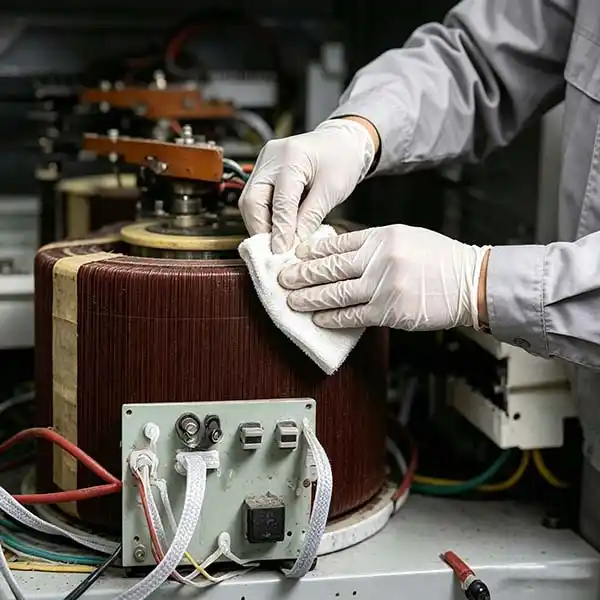
Clean the brush chamber. Remove carbon dust from the surrounding area, including the brush holder and nearby components.
Check connections. Inspect the wires and terminals connected to the carbon brush assembly. Ensure all connections are secure and free of corrosion.
Reassemble and test. Replace the casing securely and restore power. Verify that the stabilizer operates normally and that output voltage is stable.
Important safety notes:
-
Use only non-abrasive cleaning materials
-
If you find damaged components during cleaning, replace them before putting the unit back into service
-
If you are unsure about any step, consult a qualified technician
When to Replace Rather Than Clean
Cleaning is not always sufficient. Here are the signs that indicate replacement is needed:
-
Brush length is less than 20% of the original — the brush can no longer maintain proper contact pressure
-
Visible cracks, chips, or uneven wear on the brush surface
-
The coil surface shows grooves, pitting, or burn marks from prolonged sparking
-
The brush spring has lost tension — insufficient spring pressure causes poor contact and arcing
Many users find that brushes last from 6 months to 1 year, depending on use. In stable voltage environments, some users report “no need to replace carbon brushes for several years”, while in fluctuating conditions, replacement may be needed “after one year”.
For a deeper understanding of stabilizer maintenance best practices, see our related guide: Servo Voltage Stabilizer Maintenance Checklist – What to Inspect and When – coming soon.
Real-World Scenarios – How Frequency Varies by Application
To make this concrete, consider three different scenarios.
Office building with stable grid power. A small office uses a servo stabilizer to protect computer equipment. The grid is relatively stable, and the stabilizer operates in a clean, air-conditioned environment. Recommended cleaning: every 6–12 months. Visual inspection at 6 months shows minimal dust and light brush wear.
Small manufacturing workshop with moderate voltage fluctuations. A workshop runs CNC machines and welding equipment. Voltage sags occur regularly when heavy machinery starts. The stabilizer operates in a dusty environment. Recommended cleaning: every 3 months. The servo motor moves frequently, accelerating brush wear.
Agricultural or rural setting with severe fluctuations. A farm uses a servo stabilizer to protect irrigation pumps and refrigeration. Input voltage drops significantly during peak demand hours. The environment is dusty, and temperatures vary. Recommended cleaning: monthly or every 500 operating hours. Frequent, large voltage corrections cause rapid brush wear, requiring more frequent attention.
Next Steps – From Maintenance to Long-Term Reliability
By now, you should have a clear picture of how often to clean your servo stabilizer's carbon brushes: baseline every three months for most applications, with adjustments based on your environment, usage intensity, and voltage fluctuation frequency. The key decision factors are your operating environment, actual operating hours, and observed brush wear after each inspection.
Once you have established a maintenance routine, comparing stabilizer models with different brush designs and accessibilities becomes the next logical step. You can review servo automatic voltage stabilizer series for applications requiring regular maintenance access, or explore static stabilizers for environments where maintenance access is limited.
Related Reading
-
Servo Voltage Stabilizer Maintenance Checklist – What to Inspect and When
-
How to Replace Carbon Brushes on a Servo Stabilizer – A Step-by-Step Guide
-
Signs Your Voltage Stabilizer Needs Professional Servicing
-
How Operating Environment Affects Voltage Stabilizer Lifespan
-
Static vs Servo Stabilizers – Maintenance Comparison
This article is part of Honle’s technical content library. No direct sales or pricing information is included. All technical discussions aim to help you make informed purchasing decisions.