
Double Appliance Lifespan: Adding AVR to Refrigerator & AC | Honle

 Site Editor
Your refrigerator runs 24 hours a day, 365 days a year. Your air conditioner works hardest during the hottest months when the grid is under the most strain. These are not just your most expensive household appliances—they are also the most vulnerable to voltage fluctuations.
Here's the problem: the voltage that reaches your wall outlet is rarely a steady 220V or 230V. During peak demand hours, it can drop well below 200V. When heavy appliances cycle on and off, it can spike well above 240V. Your refrigerator and air conditioner have compressors with electric motors that are particularly sensitive to these variations. When voltage drops, the motor draws excessive current to compensate, which generates heat and degrades insulation. When voltage spikes, components can burn out entirely.
This guide explains exactly how voltage fluctuations damage your refrigerator and air conditioner, what an automatic voltage regulator (AVR) does to prevent that damage, and whether adding an AVR can realistically double your appliance lifespan.
How Voltage Fluctuations Damage Your Refrigerator
The refrigerator compressor is an AC motor-driven appliance that draws large currents during voltage drop conditions, which can lead to overheating of windings. Understanding the specific voltage thresholds helps explain why this matters.
| Voltage Condition | What Happens | Consequence |
|---|---|---|
| Below 187 V | Compressor cannot start properly; excessive current flows through the motor | Motor overheats, windings burn out, compressor fails |
| 187–200 V | Compressor operates but under stress; current draw higher than normal | Cumulative heat damage; gradual insulation breakdown |
| 200–230 V | Normal operating range for most refrigerators | No significant stress |
| 230–242 V | Acceptable but elevated voltage increases heat generation | Accelerated wear on electrical components |
| Above 242 V | Compressor and other electrical parts easily burn out | Catastrophic failure |
Why is low voltage especially dangerous for refrigerators? When voltage drops, the motor draws more current to maintain its workload. This increased current generates heat that is not adequately dissipated. Over time, the motor insulation degrades, the compressor runs hotter, and the risk of winding burnout increases significantly. If the refrigerator is not switched off during sustained low voltage, the compressor can heat up and get damaged or burnt.
Why is high voltage equally destructive. When voltage is too high, appliances run too fast and too hot, which shortens their service life. Components that are not designed for sustained overvoltage experience accelerated degradation, and in severe cases, immediate failure.
Real-world evidence. A study by the Australian Power Quality & Reliability Centre, awarded a $192,500 scholarship by the Victorian Department of Environment, Land, Water and Planning, is currently investigating the impact of supply voltage magnitude on consumer appliance lifespan—the first project of its kind to provide an assessment in real dollar terms. Meanwhile, an IEEE study from 2024 notes that legacy power system planning and the integration of renewable energy sources have led to both increased variation and magnitude of supply voltage, potentially affecting the efficiency, operation, and lifespan of residential appliances.
How Voltage Fluctuations Damage Your Air Conditioner
Air conditioners face similar risks, but the stakes are often higher because they run seasonally with heavy loads and are expensive to repair or replace.
| Voltage Condition | What Happens | Consequence |
|---|---|---|
| Below 198 V | AC may fail to start; compressor motor experiences excessive current draw | Frequent failed starts; eventual motor burnout |
| 198–242 V | Acceptable operating range for most household AC units | Normal operation |
| Above 242 V | Compressor motor runs too fast; components overheat | Accelerated wear; controller board damage |
The AC compressor is particularly sensitive to power supply fluctuations. Either too low or too high voltage can lead to overheating, malfunctioning, or damage to the inner workings of the compressor. Inverter-based AC units, which contain expensive digital PCBs, work best with a constant voltage input.
The hidden cost of low voltage for AC compressors. Operating an AC compressor at low voltage causes the motor to draw higher current, generating excessive heat. Long-term operation under these conditions causes the motor to operate in an inefficient, overheated state, resulting in insulation degradation and, eventually, winding burnout. Additionally, low voltage reduces the motor's output torque, which can cause startup difficulties and "stalling"—a sudden increase in current during operation that can damage the compressor.
The risk of voltage spikes. A sudden voltage spike can overwhelm the AC's internal protection circuits, damaging the electronic control board and causing the compressor to fail. Even if the damage is not immediate, repeated exposure to voltage extremes accumulates over time, significantly shortening the unit's lifespan.
What an Automatic Voltage Regulator Does—and How It Protects Your Appliances
An automatic voltage regulator is a device that detects voltage fluctuations in the input supply and automatically corrects them, ensuring your appliance receives a stable and safe voltage.
Key protection mechanisms:
| Protection Feature | How It Works | Benefit for Refrigerator/AC |
|---|---|---|
| Automatic voltage correction | Detects under-voltage and over-voltage; adjusts output to nominal level | Prevents the compressor from running at damaging low or high voltages |
| Time delay system | Delays power restoration after a power cut by 3–5 minutes | Prevents compressor damage from rapid cycling |
| Over/under voltage cut-off | Disconnects power when voltage exceeds safe limits | Protects against catastrophic voltage spikes and deep sags |
| Surge protection | Absorbs or diverts voltage spikes before they reach the appliance | Prevents damage to sensitive electronic control boards |
How this translates to longer appliance life? By ensuring that your refrigerator and air conditioner always receive voltage within their designed operating range, an AVR prevents:
-
Heat damage from low-voltage overcurrent
-
Insulation breakdown from sustained overvoltage
-
Compressor wear from frequent starts and stops without proper delay
-
Electronic component failure from voltage spikes
Some stabilizers are designed specifically for refrigerators and feature an initial time delay system that safeguards and prolongs the life of the compressor by supplying power gradually during startup.
For detailed product information on AVRs for home appliances, visit our automatic voltage stabilizer series page.
Can an AVR Really Double Appliance Lifespan?
The question of whether an AVR can "double" appliance lifespan depends on your power conditions. Here is a practical framework to assess the potential benefit.
| Your Power Conditions | Expected Benefit from AVR | Lifespan Impact |
|---|---|---|
| Voltage consistently within 200–240V; fluctuations <10V | Minimal—AVR adds little value | Little to no extension |
| Frequent drops below 187V or 198V | Significant—prevents motor overheating and burnout | Potentially doubles or more |
| Frequent spikes above 242V | Significant—prevents component failure | Potentially doubles or more |
| Regular power cuts without delay protection | Significant—time delay prevents compressor damage from rapid cycling | Significant extension |
| Unstable rural or grid-stressed area | Maximum benefit—AVR addresses multiple issues simultaneously | Substantial extension |
Real-world indicators. In regions with unstable power, using a voltage stabilizer is often considered essential rather than optional. For older appliances over five years old, a voltage stabilizer becomes particularly important. If your voltage fluctuations are big—such as more than 20V—installing a regulator is very necessary. Especially for areas where the voltage is always less than 200V or higher than 230V, a regulator is strongly recommended.
A note on modern appliances. Some newer refrigerators and inverter AC units have built-in wide-voltage tolerance. For example, some models can operate safely within 187–242V, and certain AC units are designed for 185–260V. If your appliance already has wide-voltage capability and your power is reasonably stable, an external AVR may provide limited additional benefit. However, even in these cases, the time-delay feature that prevents compressor damage from rapid power cycling remains valuable.
Practical Decision Guide—Should You Add an AVR?
Use this step-by-step framework to decide whether your refrigerator and air conditioner need an AVR.
Measure your actual voltage
Use a multimeter or plug-in voltage monitor to check your supply voltage at different times of day. Measure during:
-
Early morning
-
Midday
-
Evening peak hours
-
After a power cut
Compare against safe ranges
-
Refrigerator safe range: 187–242V
-
Air conditioner safe range: 198–242V
-
If your voltage regularly falls outside these ranges, an AVR is justified.
Consider the age of your appliances
If your refrigerator or AC is more than five years old, its internal protection may be less robust than newer models. An AVR becomes a valuable investment.
Factor in the replacement cost
A new refrigerator or air conditioner can cost hundreds or thousands of dollars. A voltage stabilizer typically costs a fraction of that. If you live in an area with known power quality issues, the AVR pays for itself by preventing just one compressor replacement.
Choose the right capacity
-
For refrigerators: A stabilizer of above 750W is suitable for most models
-
For air conditioners: Up to 1.5-ton AC typically requires a 4KVA stabilizer; 2-ton AC needs a 5KVA stabilizer
For guidance on selecting the right stabilizer for your home, explore our power solutions for residential applications.
Real-World Scenarios
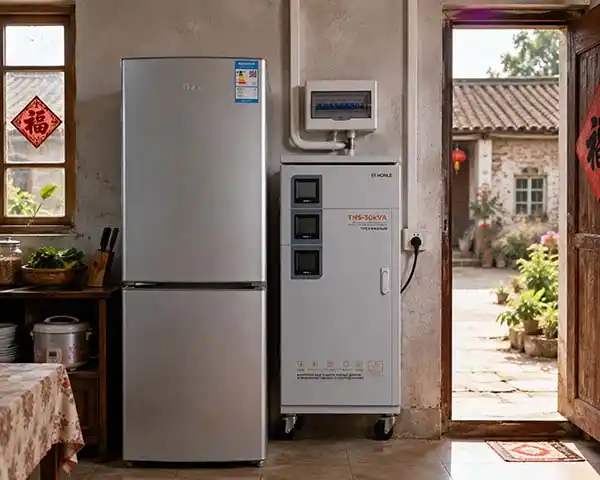
Rural home with chronic low voltage
A family in a rural area experiences voltage that drops to 160V during evening peak hours. Their refrigerator compressor cycles repeatedly at low voltage, drawing excessive current and running hot. After installing a 1KVA voltage stabilizer, the refrigerator receives a steady 220V regardless of grid conditions. The compressor runs cooler, and the family expects to avoid the $300+ compressor replacement that neighbours have experienced multiple times.
Urban apartment with frequent power cuts
An apartment in a city with regular power cuts has a 1.5-ton inverter AC. Without a stabilizer, the AC's electronic control board is at risk from voltage surges during restoration. After installing a 4KVA stabilizer with time-delay protection, the AC no longer receives sudden power after a cut—the delay allows the system to stabilize before restarting, preventing compressor damage.
Home with stable but borderline voltage
A household measures voltage at 198V during summer evenings—at the very edge of the AC's safe operating range. While not immediately dangerous, the compressor is operating under chronic stress. A small voltage stabilizer brings the voltage up to a consistent 220V, reducing the risk of long-term insulation degradation.
Next Steps—From Understanding to Action
Understanding how voltage affects your refrigerator and air conditioner is the first step. The key takeaway is clear: if your voltage regularly falls below 187V or 198V, or rises above 242V, your appliances are under stress that will shorten their lifespan. An AVR prevents that stress by delivering stable, regulated voltage.
Once you have assessed your power conditions and appliance ages, comparing specific stabilizer capacities and features becomes the next logical step. You can review single-phase automatic voltage stabilizers for whole-home protection or explore dedicated stabilizers for refrigerators and AC units for point-of-use protection.
Related Reading
-
Servo vs Relay Voltage Stabilizer – Which AVR Is Right for Your Home?
-
How to Choose the Right Capacity for Your Home Voltage Stabilizer
-
Why Your Automatic Voltage Stabilizer Keeps Clicking – 3 Fixes | Honle
-
Understanding Input Voltage Range and Why It Matters for Your Appliances
-
Common Signs Your Voltage Stabilizer Needs Maintenance or Replacement
This article is part of Honle’s technical content library. No direct sales or pricing information is included. All technical discussions aim to help you make informed purchasing decisions.