
Stop Servo Stabilizer Hunting (Oscillation) – Permanent Fix | Honle

 Site Editor
Your servo voltage stabilizer is supposed to protect your equipment—not become a source of constant clicking, humming, and erratic voltage output. But when the stabilizer begins to "hunt," that's exactly what happens. The servo motor continuously overshoots and overcorrects, creating a rhythmic oscillation that can be heard as a persistent chatter. This is not just annoying—it causes unnecessary wear on the gear train, prevents accurate voltage regulation, and can damage the stabilizer itself.
In a voltage stabilizer, hunting occurs when the servo system cannot settle at the correct output voltage. The motor constantly drives back and forth, the control transformer receives conflicting error signals, and the stabilizer never achieves stable regulation. This guide explains the four root causes of servo stabilizer hunting and provides permanent solutions—from basic adjustments to advanced anti-hunting networks.
What Is Servo Hunting – and Why Does It Happen?
Servo hunting is the mechanical oscillation of a servomechanism about its null position. In a voltage stabilizer, the "null position" is the point where the output voltage matches the set value. When the servo is displaced from this null and allowed to drive back, it has a tendency to overshoot its mark.
This overshoot creates a new error signal in the opposite direction, pulling the servo back toward the proper null position. However, it may overshoot again in the other direction. Under certain conditions, this cycle continues indefinitely—the servo oscillates about the null position, resulting in a chattering gear train.
What this means for your equipment:
-
Voltage never stabilizes – The output voltage fluctuates continuously
-
Mechanical wear accelerates – The gear train and carbon brush wear out faster
-
Noise and vibration – Audible chattering and physical vibration
-
Reduced protection – Your equipment receives unstable voltage, defeating the purpose of the stabilizer
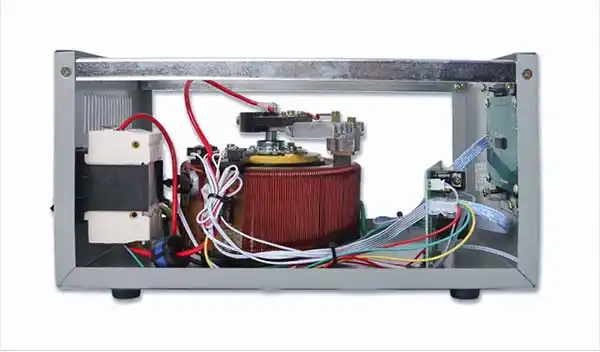
To understand how servo stabilizers are designed to prevent these issues, visit our automatic voltage stabilizer series page.
Poorly Tuned Control Loop
The problem: Servo stabilizers use a closed-loop control system to regulate voltage. The controller compares the actual output voltage with the desired value and sends correction signals to the servo motor. When the control loop is poorly tuned—particularly the proportional (P), integral (I), and derivative (D) gains—the system becomes unstable.
-
Proportional gain too high → Fast response but causes overshoot and oscillation
-
Integral gain too high → Slow oscillation and windup
-
Derivative gain too low → Insufficient damping, allowing oscillations to persist
As one expert explains, "Oscillation about a setpoint can be caused by excess gain and positive feedback, or by not enough derivative feedback". Proper tuning requires balancing these three parameters so the system responds quickly without overshooting.
Permanent fix – Systematic PID tuning:
| Step | Action | Why It Matters |
|---|---|---|
| Verify the current loop | Confirm stable torque control before adjusting higher loops | Higher-level tuning cannot compensate for an unstable foundation |
| Tune velocity loop | Increase gain until responsive, then back off for adequate damping | Manages inertia and friction; smooths motion |
| Tune position loop | Increase stiffness carefully while watching for overshoot | Determines settling time and following error |
| Validate with real conditions | Test under actual voltage fluctuation patterns | Ensures stability under real-world operating conditions |
Many modern stabilizers include auto-tune functions that can automatically adjust PID parameters. If available, running the auto-tune procedure may resolve the hunting issue. However, if the auto-tune function does not eliminate the oscillation, manual tuning by a qualified technician may be necessary.
Aging or Failed Electronic Components
The problem: Electronic components degrade over time. Capacitors lose their value, resistors drift, and op-amps can become noisy. These aging components can destabilize the control circuit, causing oscillation.
As one engineer notes, "Failure of bypass/filter capacitors can also lead to instability... capacitors may have aged and lost value". When filter capacitors lose their ability to smooth the power supply, noise enters the control circuit. This noise can be misinterpreted as a voltage error, causing the servo to hunt.
Permanent fix – Component inspection and replacement:
-
Inspect electrolytic capacitors – Look for bulging, leaking, or discoloration. Replace any that show signs of aging.
-
Check bypass capacitors – Install basic bypass capacitors on the power supply feed and the op-amp feedback path to eliminate noise.
-
Verify power supply stability – Check for any AC presence on the DC power supply feeds. If the DC supply is noisy, the control circuit will receive corrupted signals.
-
Inspect potentiometers – Trimpots used for gain adjustment can drift over time or become noisy. Verify their settings or replace them if unstable.
Note: When replacing capacitors, correct polarity is vital. Reversing polarity can damage the circuit and create additional problems.
Mechanical Issues
The problem: Servo stabilizers are electromechanical devices. The servo motor, gear train, carbon brush, and autotransformer all experience mechanical wear over time. These mechanical issues can cause or worsen hunting.
-
Worn carbon brush – Reduced contact area creates inconsistent electrical connection
-
Sticky gears – Lubrication breakdown causes friction and hysteresis
-
Non-linear friction – The mechanism sticks then suddenly releases, causing oscillation
-
Excessive mechanical load – The servo struggles with the load, causing overcorrection
Permanent fix – Mechanical inspection and maintenance:
-
Inspect and replace the carbon brush – If the brush is worn beyond 80% of its original length, replace it. A worn brush creates poor contact and erratic regulation.
-
Clean and lubricate the gear train – Remove old, dried lubricant and apply fresh, appropriate lubricant. Ensure smooth movement without binding.
-
Check for mechanical binding – Manually rotate the servo mechanism to feel for rough spots or resistance.
-
Verify the motor coupling – Use a coupling with good torsional stiffness and vibration-damping ability.
-
Check the autotransformer surface – Clean the coil surface where the carbon brush contacts. Carbon dust buildup can create intermittent contact.
Missing or Malfunctioning Anti-Hunting Network
The problem: This is the most sophisticated—and often overlooked—cause of servo hunting. In a hunting servo system, the error signal is not a pure DC or low-frequency signal. The control transformer error voltage is a carrier amplitude-modulated at the hunting frequency.
When the system hunts at, for example, 5 Hz, the servo amplifier receives two signals: one at 55 Hz and one at 65 Hz. These side-band frequencies sustain the hunting oscillation.
How the anti-hunting network works: An anti-hunting network—typically a bridged-T network—discriminates against these side-band frequencies by shifting their phase. The network attenuates the 55 Hz and 65 Hz signals while allowing the pure 60 Hz carrier to pass. Since the signals associated with hunting cannot pass through the network, hunting is quickly damped.
Permanent fix – Verify and repair the anti-hunting network:
-
Locate the anti-hunting network – In many stabilizers, this is a bridged-T network in the servo amplifier circuit.
-
Inspect for component failure – Check the resistors and capacitors in the network. A failed component can render the network ineffective.
-
Verify the network's frequency response – The network should attenuate frequencies approximately 5 Hz above and below the carrier frequency while passing the carrier with minimum attenuation.
-
Replace any failed components – If components are out of specification, replace them with exact equivalents.
The anti-hunting network does not interfere with the positioning ability of the servo when it is not hunting. If the network is functioning correctly, it silently prevents oscillation without affecting normal operation.
Practical Decision Framework – Diagnosing Your Hunting Issue
Use this step-by-step framework to identify the root cause of your stabilizer's hunting:
| Symptom | Likely Cause | Recommended Fix |
|---|---|---|
| Fast, aggressive oscillation (10+ Hz) | PID gains too high | Tune PID parameters; reduce proportional gain |
| Slow, creeping oscillation | Integral gain too high | Reduce integral gain; check for windup |
| Hunting that worsens over time | Aging components | Inspect and replace capacitors |
| Hunting that started after a "pop" or failure | Component failure | Inspect control board; replace failed components |
| Grinding or rough mechanical feel | Mechanical wear | Clean, lubricate, and replace worn parts |
| Hunting that persists after all other fixes | Missing/defective anti-hunting network | Inspect and repair bridged-T network |
| Hunting only under heavy load | Mechanical load or brush wear | Check brush contact and gear train |
For guidance on selecting stabilizers with robust anti-hunting protection, explore our power solutions for industrial and residential applications.
Real-World Scenarios
Industrial CNC workshop. A 50 kVA servo stabilizer protecting five CNC machines begins hunting persistently. The maintenance team hears a rhythmic chattering from the stabilizer. Voltage output fluctuates by ±5V continuously. Diagnosis: The stabilizer's PID gains were set too aggressively. Fix: A qualified technician reduces the proportional gain and increases the derivative gain slightly, restoring stability. The stabilizer now regulates within ±1V.
8-year-old stabilizer in a textile mill. An aging servo stabilizer starts hunting intermittently. The oscillation is worse in the afternoons when temperatures rise. Diagnosis: Electrolytic capacitors in the control circuit have aged and lost value, making the circuit temperature-sensitive. Fix: Capacitors are replaced, and the anti-hunting network is verified. The stabilizer returns to stable operation.
New stabilizer with persistent hunting. A recently installed stabilizer hunts continuously despite attempts at tuning. Diagnosis: The anti-hunting network was never properly calibrated or contains a defective component. Fix: The bridged-T network is inspected; a failed resistor is replaced. Hunting stops immediately.
Next Steps – From Diagnosis to Permanent Resolution
Understanding why your servo stabilizer hunts is the first step to a permanent fix. The four root causes—poor PID tuning, aging components, mechanical wear, and a malfunctioning anti-hunting network—each require a different approach. Start with the simplest diagnostic steps and work toward the more complex.
Once you have diagnosed the issue, comparing stabilizer models with better tuning flexibility, higher-quality components, and built-in anti-hunting protection becomes the next logical step. You can review servo-type stabilizers with advanced control features or explore static-type stabilizers that have no moving parts and are inherently immune to mechanical hunting.
Related Reading
-
How Often to Clean Carbon Brushes on a Servo Voltage Stabilizer?
-
Why Your Automatic Voltage Stabilizer Keeps Clicking – 3 Fixes
-
Servo vs Static Voltage Stabilizer – Which Technology Requires Less Maintenance?
-
Understanding Voltage Stabilizer Control Loops – A Technical Overview
-
How to Choose the Right Voltage Stabilizer Capacity for Industrial Equipment
This article is part of Honle’s technical content library. No direct sales or pricing information is included. All technical discussions aim to help you make informed purchasing decisions.