
5 Ways to Cut Power Loss in Automatic Voltage Stabilizers | Honle

 Site Editor
Your automatic voltage stabilizer runs 24 hours a day, 365 days a year. It protects your equipment from voltage fluctuations, but it also consumes electricity continuously—even when your appliances are turned off.
This is not a trivial cost. For many installations, a stabilizer's "no-load loss" can account for a significant portion of its total energy consumption. Studies show that in many workplaces, loads operate only 5 to 8 hours per day, leaving the stabilizer in an idle, energy-wasting state for the remaining 16 to 19 hours. Over a year, these idle losses add up to hundreds of kilowatt-hours—money spent on electricity that serves no productive purpose.
This guide explains five practical ways to reduce power loss in automatic voltage stabilizers, from simple operational changes to technology upgrades. Each method is explained in terms of what it does, why it works, and how much you can expect to save.
Understanding Where Power Loss Comes From
Before diving into solutions, it helps to understand the two main types of power loss in a voltage stabilizer.
No-load loss. This is the power the stabilizer consumes even when no appliances are connected or running. It comes from the transformer core's magnetization losses and the control circuit's standby power. A 10kVA stabilizer can consume approximately 64W when idle. Over a year, that's over 560 kWh of wasted electricity.
Load loss. This is the additional power lost when the stabilizer is supplying current to your appliances. It comes from resistance in the transformer windings and other components. A 10kVA stabilizer at full load can consume approximately 292W.
The table below shows estimated losses for typical stabilizer sizes:
| Stabilizer Capacity | No-Load Loss (W) | Full-Load Loss (W) | Annual Idle Waste (kWh) |
|---|---|---|---|
| 1 kVA | 16 | 28 | ~140 |
| 3 kVA | 24 | 82 | ~210 |
| 5 kVA | 32 | 146 | ~280 |
| 7 kVA | 40 | 197 | ~350 |
| 10 kVA | 64 | 292 | ~560 |
| 15 kVA | 96 | 438 | ~840 |
Source: Estimated based on mechanical industry standard ZBK42002-87 for contact-type auto-transformers
These numbers reveal a crucial point: no-load loss is often the largest source of waste. If your stabilizer runs 24/7 but your equipment only operates 8 hours a day, you are wasting power for two-thirds of the day.
For an overview of stabilizer technologies with different efficiency profiles, visit our automatic voltage stabilizer series page.
1. Install an Automatic Bypass
What it does: An automatic bypass—sometimes called a "Energy-saving mode" or "standby mode"—detects when the input voltage is already within the safe operating range for your equipment and bypasses the stabilizer entirely, connecting the load directly to the mains supply.
Why it works: The stabilizer only needs to regulate voltage when the input voltage deviates from the acceptable range. When the grid voltage is already stable, running the voltage through the stabilizer's transformer only adds unnecessary losses. By bypassing the stabilizer during these periods, you eliminate both no-load and load losses completely.
How much you can save: Studies suggest that in many areas, grid voltage is within the acceptable range for approximately half of the operating day. By bypassing the stabilizer during these periods, you can cut total energy waste by up to 70–80%. For a 10kVA stabilizer, this could save over 400 kWh annually.
Implementation: Some modern stabilizers include this feature built in. For older units, an external bypass contactor controlled by a voltage-sensing relay can achieve the same effect. The key is ensuring the bypass engages only when voltage is truly stable—never during fluctuations.
2. Choose the Right Stabilizer Technology
What it does: Different stabilizer technologies have fundamentally different efficiency profiles. Choosing the right one for your application can significantly reduce power loss.
| Technology | Typical Efficiency | Key Loss Sources | Best For |
|---|---|---|---|
| Relay | ~90% | Transformer core losses; relay contact resistance | Low-cost household applications |
| Servo | 95–97% | Transformer losses; servo motor and brush friction | General industrial loads |
| Static | 97–98%+ | Semiconductor switching losses | Sensitive electronics, high-efficiency applications |
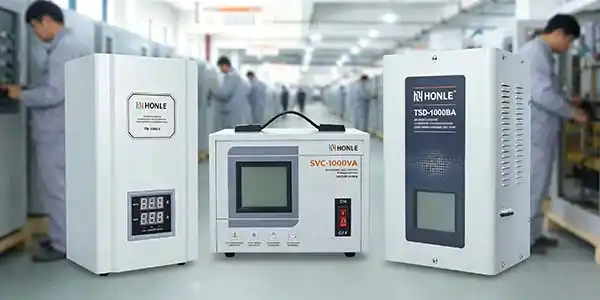
Why it works: Static voltage stabilizers use solid-state electronic components with no moving parts, resulting in minimal energy losses. Servo stabilizers, while more efficient than relay types, involve mechanical components that introduce additional energy losses.
How much you can save: Moving from a relay stabilizer to a static stabilizer can reduce power loss by approximately 80%. For a 10kVA load running 8 hours daily, this difference represents hundreds of kilowatt-hours saved annually.
Important consideration: The "best" technology depends on your application. Static stabilizers offer higher efficiency and faster response but come at a higher cost. Servo stabilizers offer a practical balance of efficiency and affordability for most industrial applications.
3. Optimize Stabilizer Sizing
What it does: Selecting a stabilizer with a capacity that closely matches your actual load—rather than oversizing "just in case."
Why it works: Transformer losses scale with capacity. A larger stabilizer has larger core and winding losses, even at the same load level. The no-load loss of a 15kVA stabilizer is 96W—50% higher than the 64W loss of a 10kVA unit. If your actual load is only 8kVA, a 10kVA stabilizer wastes less energy than a 15kVA unit while providing adequate protection.
How much you can save: Right-sizing from 15kVA to 10kVA saves approximately 32W of continuous no-load loss—over 280 kWh per year.
Implementation steps:
-
Measure your actual load using a clamp meter during peak operation
-
Allow 20–30% headroom for future expansion and startup surges
-
Avoid over-sizing beyond what you realistically need
-
Consider modular designs that allow capacity expansion later
4. Use High-Efficiency Components and Materials
What it does: Specifying stabilizers built with low-loss materials—high-grade silicon steel cores, oxygen-free copper windings, and low-resistance components.
Why it works: The transformer core is the largest source of no-load loss. Using high-magnetic-inductivity silicon steel sheets can minimize no-load loss and no-load current. High-conductivity oxygen-free copper windings reduce copper losses. Low-on-resistance MOSFETs and low-ESR capacitors further reduce losses in the control circuitry.
How much you can save: Premium materials can reduce no-load loss by 20% or more compared to standard materials. Some manufacturers using 0.23mm cold-rolled silicon steel sheets achieve no-load losses 20% lower than national standards.
What to look for when buying:
-
Core material: Cold-rolled silicon steel with high laminating factor
-
Winding material: Oxygen-free copper
-
Switching components: Low Rds MOSFETs, low-ESR capacitors
-
Transformer design: Toroidal transformers generally have lower leakage flux and losses than traditional E-I cores
5. Implement Smart Power Management
What it does: Simply turning off the stabilizer when it is not needed—or using a timer or smart switch to automate this.
Why it works: This is the simplest and most effective way to eliminate no-load loss. If your stabilizer runs 24/7 but your equipment only operates 8 hours a day, you are wasting power for 16 hours daily. Turning it off during idle periods eliminates 100% of no-load loss during those hours.
How much you can save: For a 10kVA stabilizer with 64W no-load loss, turning it off for 16 hours daily saves approximately 374 kWh per year. For larger units, the savings are proportionally greater.
Implementation options:
-
Manual switch-off: Simple but requires discipline
-
Timer switch: Automatically turns the stabilizer on/off at set times
-
Load-sensing auto shutoff: Detects when no load is present and shuts down automatically
-
Smart plug with scheduling: Allows remote control and scheduling via smartphone
Important caution: Some equipment should not be turned off abruptly. For these applications, use a stabilizer with a time-delay feature that restores power gradually after a shutdown.
Putting It All Together – A Practical Action Plan
Here is a step-by-step approach to reducing power loss in your installation:
| Step | Action | Effort Level | Potential Savings |
|---|---|---|---|
| 1 | Install a timer or smart switch to turn off the stabilizer when not needed | Low | High |
| 2 | Check if your stabilizer has an automatic bypass feature—enable it if available | Low | Medium–High |
| 3 | Measure your actual load and verify that your stabilizer is not oversized | Medium | Medium |
| 4 | When replacing an old stabilizer, choose a unit with high-efficiency materials and the right technology for your application | High | High |
| 5 | For new installations, consider static/solid-state stabilizers for maximum efficiency | High | Highest |
For guidance on selecting energy-efficient stabilizers for your application, explore our power solutions for industrial and residential applications.
Real-World Impact – What the Savings Look Like
To make this concrete, consider a typical small workshop with a 10kVA stabilizer protecting 8kVA of equipment running 8 hours per day.
| Scenario | Annual Power Loss (kWh) | Annual Cost (at $0.15/kWh) |
|---|---|---|
| No energy-saving measures | ~560 kWh (idle) + ~430 kWh = ~990 kWh | ~$149 |
| With timer shutoff | ~187 kWh (idle) + ~430 kWh = ~617 kWh | ~$93 |
| With automatic bypass (50% of operating time) | ~280 kWh (idle) + ~215 kWh = ~495 kWh | ~$74 |
| With both timer + bypass | ~187 kWh (idle) + ~215 kWh = ~402 kWh | ~$60 |
| Upgrade to static stabilizer | ~130 kWh (total loss) | ~$20 |
Note: Actual savings depend on local electricity costs, stabilizer size, and operating patterns.
The cumulative effect is substantial. For a facility with multiple stabilizers, the savings multiply. And these savings recur year after year—making energy efficiency one of the best long-term investments in power protection.
Next Steps – From Awareness to Action
Understanding where power loss comes from is the first step. The key takeaway is clear: no-load loss is often the largest and most avoidable source of energy waste in voltage stabilizers. Simple measures—like turning off the stabilizer when not in use, enabling automatic bypass, and right-sizing your equipment—can cut power loss by 50% or more with minimal effort.
Once you have assessed your current setup and identified opportunities for improvement, comparing stabilizer models with built-in energy-saving features becomes the next logical step. You can review servo-type stabilizers with automatic bypass capabilities, or explore static-type stabilizers for maximum efficiency.
Related Reading
-
Servo vs Static Voltage Stabilizer – Which Technology Requires Less Maintenance?
-
How to Choose the Right Capacity for Your Voltage Stabilizer
-
Understanding No-Load Loss and Why It Matters for Your Electricity Bill
-
Double Appliance Lifespan: Adding AVR to Refrigerator & AC | Honle
-
Automatic Bypass vs Continuous Regulation – Which Mode Saves More Energy?
This article is part of Honle’s technical content library. No direct sales or pricing information is included. All technical discussions aim to help you make informed purchasing decisions.