
SVC vs TNS Servo Voltage Stabilizer – Key Differences | Honle

 Site Editor
You’ve already decided that a servo voltage stabilizer is the right choice for your equipment—its ±1% accuracy and continuous correction protect sensitive industrial machinery from damaging voltage fluctuations. But when you look at available servo stabilizer options, you may see two different series labeled “SVC” and “TNS.” Both are servo-controlled automatic voltage regulators, yet they are not identical. Choosing between them without understanding the internal design differences could lead to either paying for features you don’t need or ending up with a unit that struggles to handle your actual load characteristics. This article explains the core engineering distinctions between SVC and TNS servo stabilizers, translates those differences into real-world operational benefits, and gives you a clear decision framework based on your application type and power environment.
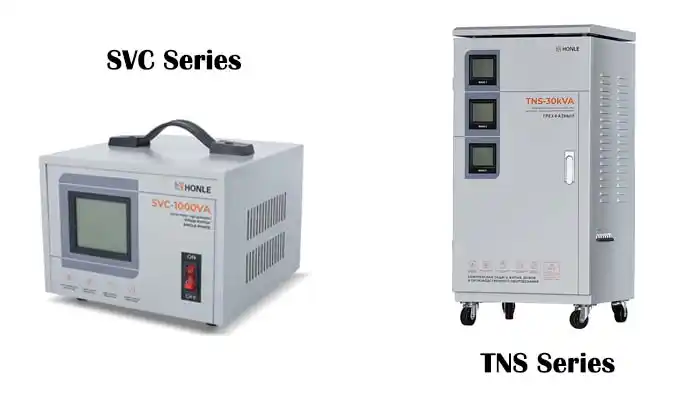
How SVC and TNS Servo Stabilizers Differ in Core Design
Both SVC and TNS stabilizers use a servo motor driven by an electronic control circuit to adjust voltage. However, the way they connect to the main power circuit is fundamentally different.
SVC series uses a single toroidal or linear autotransformer. The servo motor moves a carbon brush directly along the exposed windings of the autotransformer, changing the turns ratio and thus the output voltage. This design is compact and lightweight for a given kVA rating.
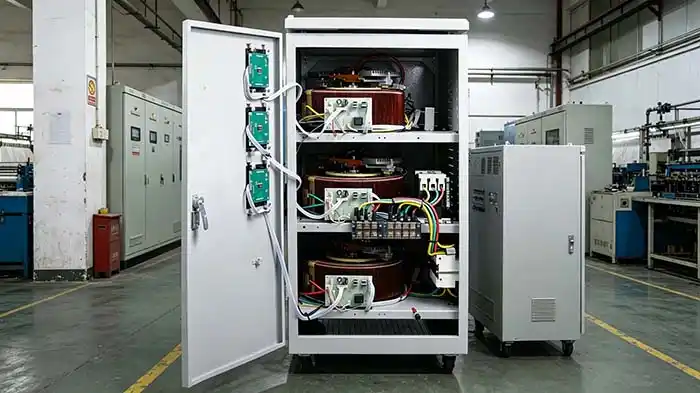
TNS series uses a separate compensating transformer in series with the main power line. The autotransformer and servo motor drive only a small portion of the total power—typically 1% to 5% of the load current—which in turn controls the compensating transformer. The main power flows through the compensating transformer, not through the carbon brush.
What this design difference means for your facility:
| Attribute | SVC Series | TNS Series |
| Power handling path | Full load current passes through carbon brush and autotransformer windings | Only control current passes through brush; main power goes through compensating transformer |
| Typical single-unit capacity | Up to 30 kVA | Up to 50 kVA |
| Carbon brush wear | Higher — full load current creates more arcing and heating | Lower — minimal control current reduces brush stress and wear |
| Efficiency at full load | >95% | >95% |
| Physical size and weight | Smaller and lighter for the same kVA rating | Larger and heavier due to built-in compensating transformer structure |
| Response speed | 20–40 ms per volt | 15–30 ms per volt |
| Overload tolerance | Moderate — overload causes excessive brush heating and arcing | Higher — compensating transformer handles overload current without stressing the brush |
The compensating transformer design of the TNS series is inherently more robust for high-power, continuous-duty industrial applications, while the SVC series offers a space- and cost-efficient solution for smaller three-phase loads.
For a closer look at how servo stabilizers are engineered, visit our automatic voltage stabilizer series overview.
Which Series Fits Your Application? A Side-by-Side Selection Guide
The choice between SVC and TNS is not about better or worse—it’s about matching the design to your specific load size, operating duty cycle, and environmental conditions.
| Decision Factor | Recommendation | Why |
| Load capacity ≤ 30 kVA | SVC or TNS both work; SVC preferred for single-phase scenarios | SVC: single-phase 0.5–30kVA, compact, low-cost for low power |
| Load capacity ≥ 1.5 kVA | TNS strongly preferred | TNS: 1.5–50kVA three-phase four-wire, independent phase regulation, exclusive three-phase option |
| Continuous 24/7 operation | TNS preferred for three-phase; SVC acceptable for single-phase with proper maintenance |
TNS: low heat loss, stable regulation, low upkeep; SVC needs frequent brush service for 24/7 use |
| Intermittent or moderate-duty single-phase loads | SVC acceptable |
SVC: high-efficiency, fast-response, controllable brush wear at non-full load for single-phase intermittent use |
| Space-constrained single-phase installation | SVC |
SVC: compact, light, smaller footprint for tight-space single-phase setup |
| Frequent voltage fluctuations | TNS preferred for three-phase; SVC for single-phase |
TNS: steady regulation, balanced 3-phase for frequent fluctuations; SVC responds in <1s for single phase |
| Budget-sensitive project with moderate single-phase load | SVC |
SVC: lower upfront cost, full protection for budget single-phase projects |
| Future expansion expected beyond 30 kVA or three-phase load | TNS |
TNS: max 50kVA 3-phase, easy expansion; SVC max 30kVA single-phase, full replacement needed for upgrades |
| Three-phase load with phase balance requirement | TNS exclusively |
TNS: three independent single-phase units, phase-by-phase regulation for balanced 3-phase output |
A note on three-phase balancing: Both SVC and TNS are available in three-phase configurations. However, TNS units are often designed with individual phase control, which is critical when your facility has unbalanced loads or large single-phase equipment on a three-phase supply. SVC three-phase units may use a common servo motor for all three phases, which cannot correct phase imbalance—only overall voltage deviation. Always verify the phase control method before purchasing.
Practical Steps to Decide Between SVC and TNS for Your Site
Here is a five-step process to determine which series aligns with your actual needs.
Calculate your actual maximum continuous load in kVA
Do not simply add nameplate ratings. Use clamp meters during peak production hours, or review utility bills for peak demand. Overestimating leads to overspending; underestimating risks overload and shutdown.
Determine your load’s duty cycle:
Is your equipment running 8 hours a day, 16 hours, or 24/7? Example: A 50 kVA load running 6,000 hours/year at 96% efficiency wastes 3,000 kWh more than at 97%—a real operating cost difference.
Assess your power fluctuation severity:
If your grid voltage swings rapidly, the servo motor will move frequently. TNS’s lower brush current means less wear per movement, extending brush replacement intervals from perhaps 2 years to 5+ years.
Check available installation space:
Measure your electrical room or panel area. TNS units are heavier and larger—a 100 kVA TNS might be 30% larger than an SVC of the same rating.
Plan for future load growth:
If you anticipate adding more machinery within 3-5 years, choose a stabilizer with spare capacity. TNS scales more gracefully to 200+ kVA without redesigning the entire voltage regulation principle.
Real-World Application Examples
To make this concrete, consider these two typical installations.
Small Plastic Molding Shop
A workshop runs four injection molding machines, each with heaters and servo-driven pumps. Load is intermittent—mold cycles create varying demand. Voltage fluctuations are moderate. A 50 kVA SVC series stabilizer fits the space, meets the load, and offers lower upfront cost. The shop checks brush wear annually and replaces brushes every 3-4 years—an acceptable maintenance routine.
Large Textile Mill
A weaving facility runs 200 looms plus air compressors and lighting. The local industrial park suffers from voltage sags every evening when neighboring plants start heavy loads. The mill needs a 300 kVA three-phase stabilizer with individual phase control to handle imbalance. A TNS series unit is the clear choice—it handles the high continuous power, its higher efficiency saves thousands per year, and the reduced brush wear means minimal maintenance downtime.
For more guidance tailored to your industry, explore our industrial power solution pages.
Other Servo Stabilizer Features to Compare Beyond Series Type
While SVC vs TNS is a major design distinction, other specifications matter equally for reliable operation:
-
Input voltage range – A wider range is essential in rural or weak grid areas.
-
Output voltage accuracy – Most servo stabilizers claim ±1%, but verify under varying load and temperature.
-
Response time – Measured in milliseconds per volt. Faster is better for protecting sensitive electronics.
-
Protection features – Over-voltage, under-voltage, over-temperature, phase loss, phase sequence, and short-circuit protection.
-
Display and monitoring – Digital meters, remote monitoring, or audible alarms.
-
Cooling method – Natural convection for smaller units; forced air for high-power TNS units.
When comparing specific models, always request datasheets that specify performance under worst-case conditions, not just typical or nominal values.
Next Steps – From Design Understanding to Specification
By now, you should be able to categorize your application: small to medium intermittent loads with space constraints point toward SVC; large continuous loads, severe fluctuations, or future expansion point toward TNS. The key decision factors are continuous load capacity, duty cycle, expected brush wear tolerance, and available installation space.
Once you have clarified these operational parameters, comparing the exact technical specifications of available stabilizer models becomes the logical next step. You can review Honle’s SVC series for compact three-phase applications up to 100 kVA, or explore the TNS series for heavy-duty, high-efficiency industrial protection.
For a related decision guide, see our article: How to Select the Correct Voltage Stabilizer Capacity for Motor Loads – coming soon.
Related Reading
-
Single-Phase vs Three-Phase Servo Stabilizers – Which Do You Need?
-
Understanding Input Voltage Range and Why Wider Is Not Always Better
-
Carbon Brush Maintenance for Servo Stabilizers – What to Expect
-
Servo vs Relay Voltage Stabilizer – Which AVR Is Right for You?
-
Servo Stabilizer vs Static Stabilizer – Pros, Cons, and Cost Comparison
This article is part of Honle’s technical content library. No direct sales or pricing information is included. All technical discussions aim to help you make informed purchasing decisions.