
Servo vs Relay Voltage Stabilizer – Which AVR Is Right for You?

 Site Editor
Power supply fluctuations—over-voltage during off-peak hours and under-voltage when demand peaks—put your electrical equipment at risk every day. For motors, voltage deviation can cause overcurrent that damages insulation and shortens service life. For sensitive electronics, even small fluctuations can lead to malfunction or cumulative component stress. If you're looking at automatic voltage regulators (AVRs) and see options labeled “servo” and “relay,” the decision can be confusing. The two technologies operate on fundamentally different principles, and choosing the wrong type can mean either paying for precision you don’t need—or leaving sensitive equipment dangerously unprotected. This guide breaks down how each technology works, what the numbers actually mean for your equipment, and how to match the right AVR to your specific power environment.
How Servo and Relay Voltage Stabilizers Work—And What That Means for Your Equipment
The fundamental distinction between servo and relay voltage stabilizers is continuous correction vs. step correction. This single design difference drives every other performance metric that matters to your equipment.
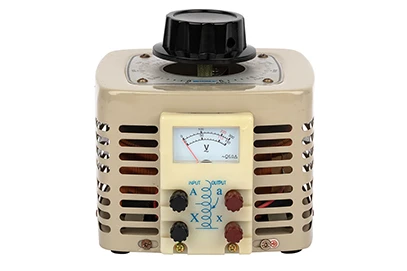
Servo Voltage Stabilizer uses an electronic control circuit that continuously monitors input voltage. When a deviation is detected, the circuit activates a servo motor, which drives a carbon brush along the windings of an autotransformer, smoothly adjusting the turns ratio until output voltage returns to the set value. Because the brush moves continuously, voltage correction is seamless and uninterrupted.
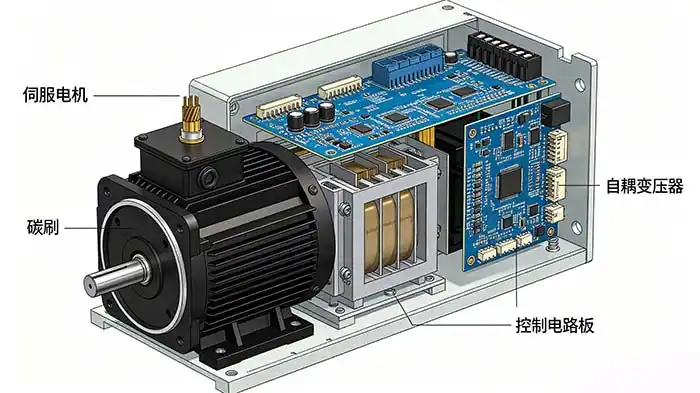
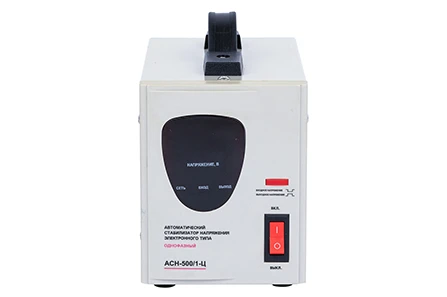
Relay Type Voltage Stabilizer uses an electronic circuit to compare input voltage against a reference. When the voltage deviates beyond a preset threshold, the circuit triggers a relay, which switches to a different tap on the transformer. This happens in discrete “steps”—the output voltage jumps from one level to the next, not smoothly.
What this means for your equipment:
-
Continuous servo correction → No output interruption, no flicker, and no sudden voltage jumps that could stress sensitive components.
-
Stepwise relay switching → A brief moment of voltage interruption during relay switching, which can cause visible flicker in lighting and may affect some sensitive electronics.
Additionally, efficiency differs significantly between the two types. Servo systems typically operate at 95% to 97% efficiency, while relay types are less efficient—generally around 90%—due to constant switching losses. Over years of continuous operation, that efficiency gap translates directly into higher energy costs for relay-based units.
→ For more details on servo stabilizer technology, visit our servo automatic voltage stabilizer product page.
Side-by-Side Comparison: Accuracy, Speed, and Capacity
The following comparison table summarizes the key performance differences between servo and relay voltage stabilizers.
| Parameter | Servo Voltage Stabilizer | Relay Type Voltage Stabilizer |
|---|---|---|
| Voltage Regulation Accuracy | ±1% of set value | ±5% to ±10% of set value |
| Input Voltage Range | Up to ±50% variation | Typically ±15% to ±6% |
| Correction Method | Smooth, continuous | Stepped |
| Output Interruption | None | Brief interruption during relay switching |
| Typical Efficiency | 95% – 97% | Approx. 90% |
| Power Capacity Range | 1 kVA to 3,000+ kVA | Typically <5 kVA per phase |
| Durability / Service Life | High; mechanical parts require periodic maintenance | Relay contact wear; shorter life under frequent switching |
| Best For | Sensitive equipment, industrial machinery, medical devices | Basic home appliances, lighting, general loads |
Sources: Servo stabilizer performance specifications based on Fuji Electric technical guide; relay accuracy and efficiency based on industry benchmarks.
A Practical Decision Guide – Matching Stabilizer Type to Your Power Scenario
The choice between servo and relay is not about which is “better” in absolute terms—it’s about which is better for your specific situation. Here’s a step-by-step framework to guide your decision.
Assess Your Local Power Quality
The severity and frequency of voltage fluctuations in your area are the starting point.
| Power Condition | Recommended Type |
|---|---|
| Mild fluctuations (±10% from nominal), infrequent dips/surges | Relay may suffice |
| Severe fluctuations (±20% or more), frequent sags or swells | Servo strongly preferred |
| Extreme low voltage (below 100V or 50V in some cases) | Neither—consider static/thyristor type instead |
*Note: In ultra-low-voltage environments, servo motor stabilizers may adjust too slowly because the motor brush must slide a long distance. Relay or thyristor types are often better in these extremes.*
Identify Equipment Sensitivity
| Equipment Type | Sensitivity to Voltage Fluctuation | Recommended Stabilizer |
|---|---|---|
| Lighting, water pumps, refrigerators, general HVAC | Low (±10% tolerance acceptable) | Relay |
| CNC machines, PLC-controlled industrial equipment, laboratory instruments | High (±1% required) | Servo |
| Medical diagnostic equipment (MRI, CT, X-ray), semiconductor manufacturing | Very high | Servo or static |
| Motors | Medium—voltage deviation causes overcurrent and insulation stress | Servo for critical motors, relay for non-critical |
Calculate Total Load and Allow for Future Expansion
For servo stabilizers, capacities range from 1 kVA to 3,000+ kVA, making them suitable for both single-phase and three-phase industrial applications. Relay stabilizers are typically designed for low-power single-phase applications below 5 kVA. If you expect load growth—adding more machines or expanding production lines—servo stabilizers offer much greater headroom.
Decide How Much Precision Your Application Truly Needs
Relay stabilizers maintain output voltage within ±5% to ±10% of the set value. For most household appliances—refrigerators, ACs, water pumps—that is perfectly adequate. But for CNC machining, medical imaging, or laboratory equipment, a ±10% variation can cause rejected parts, inaccurate readings, or equipment damage. Servo stabilizers achieve ±1% accuracy, protecting these high-value assets.
Factor In Maintenance and Total Cost of Ownership
Servo stabilizers have moving parts—the servo motor, carbon brush, and autotransformer require periodic maintenance. Relay stabilizers have no servo motor to service, but the electromechanical relays are subject to contact wear, oxidation, and pitting over time, which can lead to poor contact and eventual failure. If your area experiences frequent voltage fluctuations causing relays to switch hundreds of times per day, a servo unit may actually last longer.
A note on long-term energy costs: A servo stabilizer operating at 97% efficiency wastes 3% of energy as heat; a relay stabilizer at 90% efficiency wastes 10%. For a 50 kVA industrial load running 24/7, that 7% efficiency difference can translate into thousands of dollars in additional electricity costs each year—potentially exceeding the upfront price difference between the two units.
Real-World Application Scenarios
To make this concrete, let’s examine two typical use cases.
Small Manufacturing Shop with CNC Machinery
A workshop operates three CNC milling machines, each worth $50,000. The local grid voltage varies from 190V to 260V throughout the day due to nearby industrial loads. Relays switching in ±10% steps would mean each CNC machine experiences frequent voltage jumps—potentially causing tool chatter, surface finish defects, or even servo drive faults. Servo stabilizers maintaining ±1% output keep the CNC machines operating within their design voltage window, protecting both product quality and expensive repair costs.
Residential Building with Standard Appliances
An apartment has refrigerators, LED lighting, ceiling fans, and a window AC unit. Power fluctuates between 210V and 250V—within a ±10% band. A properly sized relay stabilizer handles these fluctuations adequately. Spending extra on servo precision would provide no tangible benefit for these appliances.
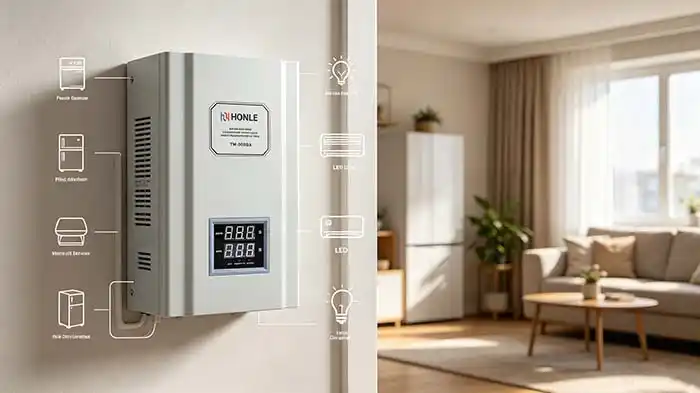
→ For more detailed application guidance, visit our solution guides for industrial and residential applications.
Beyond Servo and Relay – When to Consider Other Technologies
Two additional stabilizer technologies are worth knowing about, as they may be optimal for certain scenarios.
Static Voltage Stabilizers use solid-state electronics with no moving parts, offering instantaneous correction, 98%+ efficiency, and silent operation. They are ideal for the most demanding applications—medical imaging, semiconductor fabs, data centers—where both precision and zero maintenance are critical. However, they come at a premium cost.
Thyristor (SCR) Stabilizers combine fast response with high accuracy, operate completely silently with no mechanical wear, and have essentially unlimited lifespan under normal use. For users who need both speed and precision, SCR stabilizers are worth investigating.
Note: The “best” technology always depends on your specific combination of power quality, load sensitivity, budget, and expected operating hours. No single type is universally optimal.
Next Steps – From Understanding to Selection
By now, you should be able to classify your application into one of several categories: basic home appliances, sensitive industrial equipment, or ultra-sensitive/critical infrastructure. The key decision factors are required voltage accuracy, expected load capacity, frequency of voltage fluctuations in your area, and total cost of ownership including energy efficiency.
Once you have clarified these factors, comparing specific specifications and protection features becomes the next logical step. You can review Honle’s SVC/TNS/SBW series servo voltage stabilizers for high-precision industrial scenarios, or explore TM/UPR series relay-type stabilizers for cost-effective household applications.
→ For a deeper dive into stabilizer selection criteria, check out our related guide: How to Choose the Right Capacity and Phase Configuration for Your Voltage Stabilizer.
Related Reading
-
How to Calculate the Correct kVA Rating for Your Voltage Stabilizer
-
Single-Phase vs Three-Phase Voltage Stabilizers – Which Configuration Do You Need?
-
Understanding Input Voltage Range and Why It Matters for Your Local Grid
-
Automatic Voltage Regulator vs Uninterruptible Power Supply – What’s the Difference?
-
Common Signs Your Voltage Stabilizer Needs Maintenance or Replacement
This article is part of Honle’s technical content library. No direct sales or pricing information is included. All technical discussions aim to help you make informed purchasing decisions.