
How Does an Automatic Voltage Regulator Protect My Machinery from Voltage Spikes and Sags?

 Site Editor
Every industrial facility knows the feeling. A CNC machine stops mid-cycle. A PLC-controlled production line faults out. A motor trips unexpectedly. In most cases, the culprit is not mechanical failure—it is voltage instability.
Voltage spikes and sags are among the most common power quality issues affecting industrial equipment. They are also among the most preventable. Yet many facility managers continue to treat them as unavoidable operating costs, accepting unplanned downtime, scrap rates, and premature motor replacement as part of doing business.
They are not. An automatic voltage regulator—often shortened to AVR—is designed specifically to address these exact problems. Understanding how it works, and what it protects against, is the first step toward making a smarter investment in your power infrastructure.
Voltage Spikes and Sags: What They Are and Why They Matter
Before looking at how an industrial automatic voltage regulator provides protection, it helps to understand what you are protecting against.
A voltage sag is a short-duration drop in voltage, typically caused by large motors starting up, welders operating, or heavy loads cycling on and off. The voltage may drop to 40% to 70% of nominal levels for several cycles. During that brief window, sensitive equipment can lose power, shut down, or produce errors.
A voltage spike or swell is the opposite—a sudden, brief increase in voltage. Spikes can occur when large loads are switched off, during lightning strikes, or as a result of utility grid switching. Even a spike lasting a fraction of a second can damage the insulation on motor windings, fry control boards, and degrade electronic components over time.
The damage is not always immediate. Repeated exposure to voltage fluctuations causes cumulative stress on motors, drives, and controllers. Insulation breaks down. Bearings wear faster. Circuit boards develop intermittent faults. Eventually, equipment fails earlier than expected—and the repair or replacement cost lands squarely on your maintenance budget.
How an Automatic Voltage Regulator Works to Protect Your Equipment
An automatic voltage regulator is a device that maintains a constant output voltage despite fluctuations in input voltage or changes in load conditions. It does this through a closed-loop feedback system: the regulator continuously samples the output voltage, compares it against a reference, and adjusts the power stage to keep the output within a safe range.
In practice, this means the AVR is constantly monitoring your power supply—dozens or hundreds of times per second—and making corrections before voltage deviations reach your equipment. When a sag begins, the regulator compensates almost instantly. When a spike occurs, it absorbs or diverts the excess voltage. Your machinery never sees the disturbance.
For generator applications, the automatic voltage regulator controls the field excitation current of the alternator, ensuring stable power delivery regardless of load variations. For broader industrial protection, the AVR sits between the mains supply and your equipment, correcting voltage deviations before they can cause damage.
Servo-Controlled vs. Relay-Type AVRs
Not all automatic voltage regulators offer the same level of protection. The two most common types—servo-controlled and relay-type—operate on fundamentally different principles.
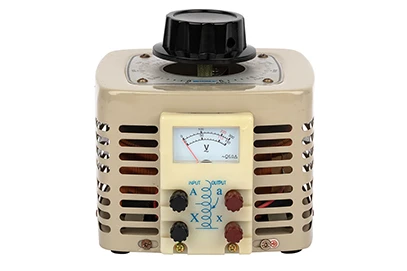
A servo automatic voltage regulator uses an electronic control circuit that continuously monitors input voltage. When a deviation is detected, the circuit activates a servo motor, which drives a carbon brush along the windings of an autotransformer, smoothly adjusting the turns ratio until output voltage returns to the set value. Because the brush moves continuously, voltage correction is seamless and uninterrupted. A quality servo-controlled unit can maintain output voltage within ±1% accuracy.
A relay-type voltage regulator uses an electronic circuit to compare input voltage against a reference. When the voltage deviates beyond a preset threshold, the circuit triggers a relay, which switches to a different tap on the transformer. This happens in discrete steps—the output voltage jumps from one level to the next, not smoothly. Relay-type units typically offer accuracy in the ±5% to ±10% range.
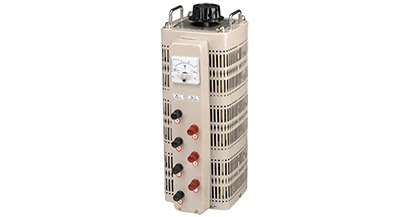
The difference matters for your equipment. Continuous servo correction means no output interruption, no flicker, and no sudden voltage jumps that could stress sensitive components. Stepwise relay switching involves a brief moment of voltage interruption during switching, which can affect sensitive electronics and cause visible flicker in lighting.
For industrial machinery, CNC equipment, medical devices, and automated production lines, the servo automatic voltage regulator is the clear choice. Relay-type units are better suited for basic home appliances and general loads.
What Protection Features Should You Look For?
A well-designed automatic voltage regulator offers multiple layers of protection beyond basic voltage correction. When evaluating AVRs for your facility, look for the following features:
Overvoltage protection safeguards your equipment against sustained high voltage conditions that can overheat motors and damage insulation.
Undervoltage protection prevents equipment from operating at voltages too low for proper function, which can cause motors to draw excessive current and overheat.
Overload protection ensures the regulator shuts down or limits output when the connected load exceeds its rated capacity, preventing damage to both the regulator and your equipment.
Delay output prevents the regulator from immediately re-energizing equipment after a power interruption, allowing the system to stabilize before reconnection.
Some advanced models also include overtemperature protection, phase failure protection, and phase-sequence protection for three-phase applications.
Why Precision Matters for Your Production Line
The accuracy of your automatic voltage regulator directly affects the reliability of your production line. A servo-controlled unit delivering ±1% regulation means that on a 400V three-phase system, the output stays within 4V of the set point. For sensitive equipment—PLC controllers, servo drives, CNC controls—that level of stability is essential.
A relay-type unit with ±8% regulation, by contrast, allows the output to drift by 32V on the same system. That is the difference between consistent, predictable operation and intermittent faults that are difficult to diagnose and expensive to resolve.
When you factor in the efficiency difference—servo systems typically operate at 95% to 97% efficiency, while relay types are less efficient at around 90%—the long-term cost equation becomes clear. Over years of continuous operation, that efficiency gap translates directly into higher energy costs.
Choosing the Right Automatic Voltage Regulator for Your Application
Selecting the right industrial automatic voltage regulator depends on several factors:
Load type and sensitivity – CNC machines, PLC-controlled production lines, and medical imaging systems require servo-level precision. Lighting, heating elements, and general loads may be adequately served by relay-type units.
Power capacity – AVRs are available from small single-phase units to large three-phase systems exceeding 3,000 kVA. Match the regulator's capacity to your connected load, with some margin for future expansion.
Input voltage range – Consider the typical voltage fluctuations in your area. Some regulators can handle up to ±50% variation, while others are limited to ±15%.
Phase configuration – Single-phase regulators serve residential and light commercial applications. A three phase automatic voltage regulator is required for industrial machinery and heavy equipment.
Environmental conditions – If your facility has temperature extremes, high humidity, or dust, choose a regulator rated for those conditions.
Have a specific power protection challenge in mind?
Whether you are protecting a single CNC machine or an entire production facility, the right automatic voltage regulator makes the difference between reliable operation and costly downtime. Our team can help you assess your power environment, calculate your load requirements, and recommend the right AVR configuration for your specific application.