
Next-Gen Voltage Stabilizers with IoT Remote Monitoring | Honle

 Site Editor
Your voltage stabilizer sits quietly in the corner of your facility, doing its job—until it doesn't. Traditional stabilizers are passive devices: they regulate voltage when fluctuations occur, but they offer no insight into their own health, no warning before a component fails, and no visibility into the power quality trends that could predict future problems. In an era where industrial facilities lose an estimated 9% to 17% of annual sales due to power disruptions and equipment damage caused by erratic voltage, this lack of intelligence is increasingly costly. Next-generation voltage stabilizers with IoT remote monitoring are changing that paradigm.
By embedding connectivity, sensors, and cloud-based analytics into voltage regulation equipment, these smart devices transform a passive protector into an active, data-generating component of your facility's power management ecosystem. This article explores what IoT-enabled voltage stabilizers are, how they work, what benefits they deliver, and what to consider when evaluating them.
What Makes a Voltage Stabilizer “Next-Generation”?
The transition from traditional to next-generation voltage stabilizers represents a fundamental shift in how power protection equipment is designed, deployed, and managed.
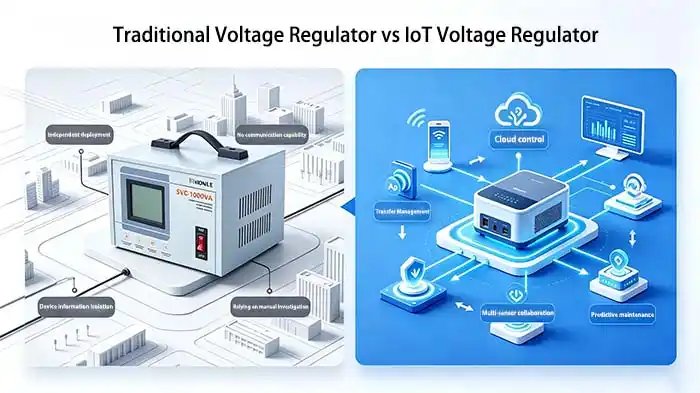
Traditional stabilizers are essentially mechanical or electromechanical devices. They detect voltage deviations and correct them—but they operate in isolation. You cannot monitor their performance remotely. You cannot receive alerts when they are under stress. You cannot analyze historical data to predict when maintenance is due. You only discover a problem when equipment fails or the stabilizer itself stops working.
Next-generation IoT-enabled stabilizers incorporate several key technologies:
-
Connectivity: Built-in Wi-Fi, Ethernet, or cellular communication modules that transmit data to cloud platforms or local servers.
-
Sensors: Embedded sensors that continuously monitor input/output voltage, load current, temperature, and other critical parameters.
-
Microprocessor control: Advanced microcontrollers—often 32-bit—that process sensor data in real time and execute sophisticated control algorithms.
-
Cloud analytics: Data aggregated from multiple stabilizers is analyzed to identify patterns, detect anomalies, and generate actionable insights.
-
User interface: Mobile apps and web dashboards that provide real-time visibility and control from anywhere in the world.
Some advanced systems are also incorporating AI-based pattern analysis that can alert customers if wiring in their homes or factories is degrading, serving as an early warning system for electrical fires. Research has also explored using Support Vector Machine (SVM) techniques to detect and compensate for voltage fluctuations in Industrial IoT networks.
For an overview of stabilizer technologies that can be enhanced with IoT capabilities, visit our automatic voltage stabilizer series page.
How IoT Remote Monitoring Works – The Architecture
Understanding the architecture of an IoT-enabled voltage stabilizer helps clarify what it can and cannot do.
The device layer
At the hardware level, the stabilizer itself remains a voltage regulation device—whether servo-based, static, or relay-type. What changes is the addition of a communication module and a microcontroller that interfaces with the stabilizer's control circuits. Sensors embedded in the device continuously measure voltage levels, current, temperature, and component status.
The connectivity layer
Data from the stabilizer is transmitted via communication protocols such as Wi-Fi, Ethernet, RS-485, Modbus, or cellular networks. For industrial environments, protocols like Modbus TCP/RTU and CAN bus are common. Some advanced systems also support IEC 61850—an international standard for communication in smart grids and digital substations—enabling integration with utility-grade infrastructure.
The cloud/platform layer
Data is aggregated in cloud-based platforms or local servers. Here, it is stored, analyzed, and made accessible through dashboards and mobile applications. Platforms often include:
-
Real-time voltage and load displays
-
Historical trend analysis
-
Alert and notification engines
-
Predictive maintenance algorithms
The user layer
Facility managers, maintenance teams, and equipment owners access the system through:
-
Mobile apps that provide real-time monitoring and alerts
-
Web dashboards for detailed analysis and reporting
-
API integrations with building management systems or enterprise software
A practical example: a 2025 study demonstrated an IoT-based microcontroller voltage stabilizer that could regulate input voltages ranging from 140V to 250V while enabling real-time wireless monitoring of voltage levels through the Blynk application.
Key Benefits – From Reactive to Proactive Power Protection
The shift to IoT-enabled stabilizers delivers tangible benefits that go far beyond basic voltage regulation.
Real-time visibility from anywhere
Facility managers can monitor power health in real-time from anywhere in the world via a smartphone or computer. This is particularly valuable for organizations with multiple sites, remote facilities, or limited on-site technical staff. Instead of discovering a problem when equipment fails, you can see developing issues as they happen.
Predictive maintenance
Perhaps the most significant benefit is the transition from reactive to predictive maintenance. Traditional stabilizers are serviced on a fixed schedule—or worse, only when they fail. IoT-enabled stabilizers continuously track critical parameters and can predict potential failures before they occur. By analyzing data trends and performance metrics, these devices can identify when a component is approaching the end of its useful life. This reduces unplanned downtime, extends equipment life, and lowers maintenance costs.
Reduced downtime and operational costs
With predictive maintenance and real-time alerts, issues can be addressed before they cause interruptions. Studies show that IoT and smart grid integration in voltage regulators enables better system efficiency, increased downtime minimization, and predictive maintenance. Data analysis capabilities also help organizations optimize energy consumption and improve overall system reliability.
Data-driven decision making
Historical data on voltage fluctuations, load patterns, and equipment performance enables better decisions about capacity planning, equipment selection, and maintenance scheduling. Instead of guessing when to upgrade or replace equipment, you have data to support your decisions.
Integration with broader energy management
Modern regulators are increasingly embedding communications that allow them to feed real-time voltage and load data into home energy dashboards, inverter controllers, and utility aggregation platforms. This convergence enables features like scheduled voltage conditioning during peak prices and coordinated operation with battery storage.
For guidance on selecting stabilizers for different industrial environments, explore our power solutions for industrial and residential applications.
A Practical Decision Framework – Evaluating IoT-Enabled Stabilizers
Not all IoT-enabled stabilizers are created equal. Use this framework to evaluate options.
Define your monitoring requirements. What do you need to monitor?
-
Basic: input/output voltage, load current
-
Intermediate: temperature, efficiency, number of correction events
-
Advanced: harmonic distortion, power factor, predictive wear indicators
Assess connectivity options. Consider your facility's infrastructure:
-
Is Wi-Fi available and reliable at the installation location?
-
Do you prefer cellular connectivity for independence from local networks?
-
Do you need industrial protocols like Modbus or IEC 61850 for integration with existing systems?
Evaluate the platform and user interface. The hardware is only as good as the software that supports it:
-
Is the mobile app intuitive and reliable?
-
Does the web dashboard provide the analytics you need?
-
Are alerts customizable?
-
Is data stored securely and accessible for historical analysis?
Consider predictive maintenance capabilities. Not all IoT stabilizers offer true predictive maintenance:
-
Does the system simply report data, or does it analyze it?
-
Are there algorithms that detect anomalies and predict failures?
-
Can you set custom thresholds for alerts?
Assess total cost of ownership. IoT-enabled stabilizers typically have higher upfront costs than traditional units. However, the business case should consider:
-
Reduced downtime costs
-
Lower maintenance expenses
-
Extended equipment life
-
Energy optimization savings
Check for future-proofing. As technology evolves, can the system be upgraded?
-
Are firmware updates delivered over-the-air?
-
Can communication modules be swapped or upgraded?
-
Is the platform compatible with emerging standards?
Real-World Applications and Market Trends
The adoption of IoT-enabled stabilizers is accelerating across multiple sectors.
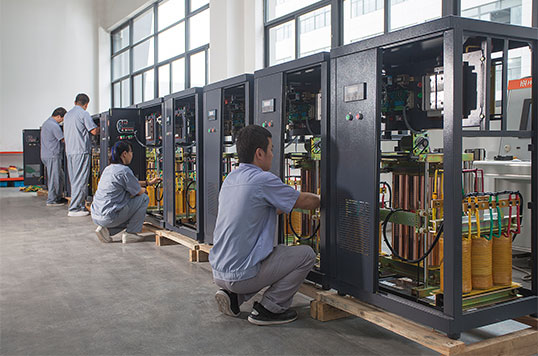
Industrial manufacturing. Facilities with CNC machines, robotic systems, and automated production lines are prime candidates. These operations are highly sensitive to voltage fluctuations, and downtime costs are substantial. IoT stabilizers provide the visibility needed to prevent interruptions and optimize maintenance schedules.
Data centers and digital infrastructure. Global data center energy usage has doubled since 2022. For AI and cloud services to remain operational, these facilities need ultra-stable electricity. IoT-enabled stabilizers with real-time monitoring and predictive maintenance are becoming essential.
Healthcare facilities. Hospitals and clinics cannot afford power-related equipment failures. IoT stabilizers provide the early warning and remote monitoring capabilities that help maintain critical equipment availability.
Residential and commercial buildings. The residential voltage regulator market is expected to grow from $338.3 million in 2024 to $704.9 million by 2034, at a CAGR of 7.6%. Installers and OEMs are bundling regulators with software subscriptions that provide remote monitoring, alerts, and predictive maintenance—shifting revenue models from one-time hardware sales toward recurring services. Companies are focusing on compact designs, faster correction speeds, and integration of IoT features for remote monitoring and predictive maintenance alerts.
Renewable energy integration. As solar and wind power become more prevalent, voltage stabilizers are integrating with these technologies to stabilize grid fluctuations. IoT connectivity enables better coordination between renewable sources, storage, and grid infrastructure.
The Future – What's Next for Smart Voltage Stabilizers?
The trajectory is clear: voltage stabilizers are becoming intelligent, connected devices that are integral to broader energy management ecosystems.
AI and machine learning integration. Advanced analytics and machine learning algorithms will enable increasingly sophisticated predictive maintenance and automated optimization. Research is already exploring deep learning neural network algorithms for voltage stability control and monitoring.
Deeper smart home integration. Residential voltage regulators are transforming from stand-alone stabilizers into integrated components of home energy management ecosystems. Interoperability with smart thermostats, EV chargers, and PV inverters is becoming a de-facto expectation in advanced markets.
Modular and upgradeable designs. Manufacturers are moving toward modular regulator designs that can be scaled or upgraded in the field—reducing SKUs, simplifying certification, and lowering lifecycle costs.
Utility integration and demand response. Regulators are being included in utility-led demand-response programs, where they can participate in grid stabilization efforts.
Related Reading
-
How to Choose Between Servo and Static Voltage Stabilizers for Industrial Applications
-
Understanding Predictive Maintenance for Power Protection Equipment
-
The Role of Voltage Stabilizers in Smart Grid and Renewable Energy Integration
-
Remote Monitoring Best Practices for Distributed Facilities
-
Total Cost of Ownership: Traditional vs IoT-Enabled Voltage Stabilizers
This article is part of Honle’s technical content library. No direct sales or pricing information is included. All technical discussions aim to help you make informed purchasing decisions.